Get Full Government Meeting Transcripts, Videos, & Alerts Forever!
Get email alerts on the Energy Storage topic
No spam. Unsubscribe anytime.
Planning commission finds energy‑storage proposal not in accord with comprehensive plan and recommends denial
Summary
The commission concluded that the Summer Sweet 50‑MW energy‑storage project near Morrisville is not substantially in accord with the county comprehensive plan and forwarded the special‑exception application to the Board of Supervisors with a recommendation of denial, citing proximity to a school, groundwater and an ongoing zoning violation on the property.
The Fauquier County Planning Commission voted 4–1 to find that the proposed 50‑megawatt Summer Sweet Energy Center is not substantially in accord with the county comprehensive plan and then recommended denial of the project’s special‑exception application to the Board of Supervisors.
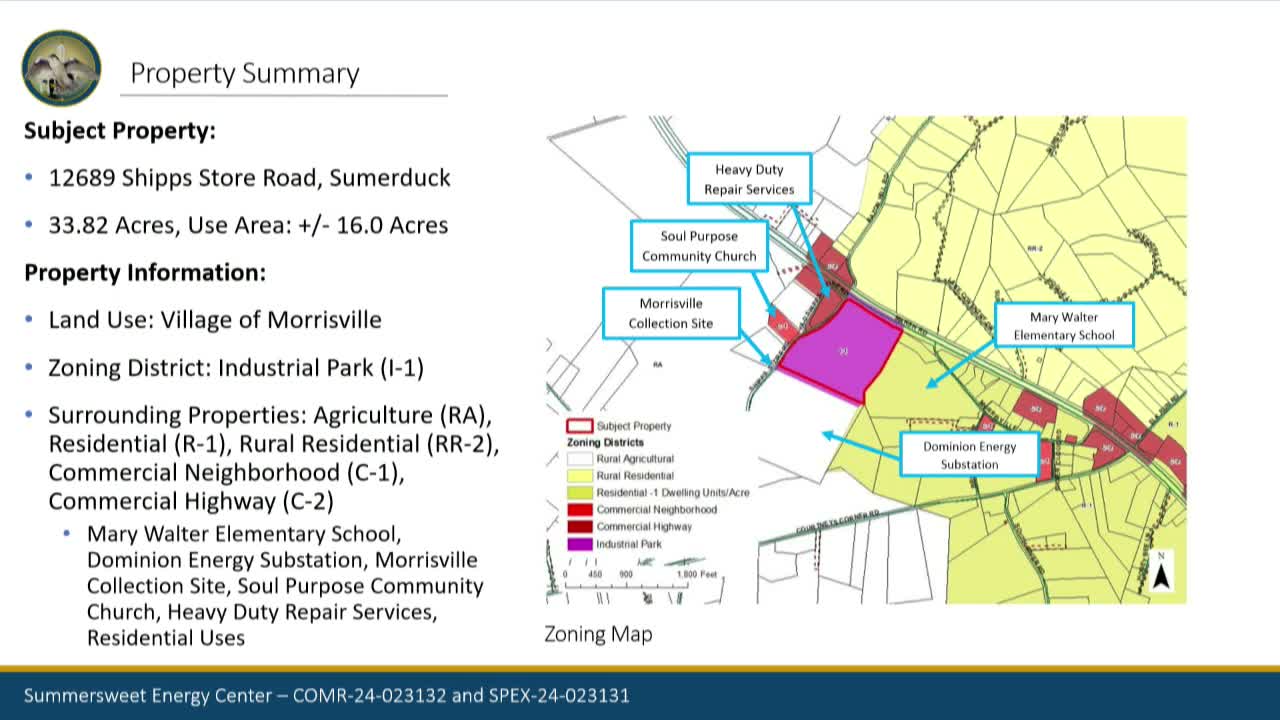
Staff presented the project as an electrical distribution‑connected energy storage facility proposed on approximately 16 acres within a ~34‑acre parcel. The design includes about 204 battery enclosures, an approximately 60‑by‑40‑foot control house, perimeter walls, stormwater controls and a decommissioning plan. Staff told commissioners the proposal would be regulated under NFPA 855 and that enclosures could be certified to UL 9540A standards.
Chris Meyer, lead developer for Eastpointe Energy, described the project’s safety systems, monitoring and a phased construction plan that would allow the operator to maintain capacity as batteries degrade over a 15–20 year lifecycle. “These batteries can be recycled and are not simply landfilled,” Meyer said, and he outlined coordination with fire and rescue and a standing emergency‑response plan.
Commissioners expressed substantial concern about the site’s proximity to Mary Walter Elementary School, groundwater‑contamination risk, and an ongoing zoning enforcement case involving stored vehicles on the property. Lead commissioner Meadows said those proximity and long‑running compliance issues made it difficult to conclude the project met the health, safety and welfare components of the comprehensive plan.
The commission adopted a motion finding the project not in substantial accord with the comprehensive plan and then voted to forward the special‑exception application to the Board of Supervisors with an unfavorable recommendation. Commissioners asked staff to include the zoning enforcement history and the comprehensive‑plan rationale in the referral packet.
The Board of Supervisors will receive the commission’s findings and the full project record prior to any further action.