Get Full Government Meeting Transcripts, Videos, & Alerts Forever!
Get email alerts on the Noise Monitoring Pilot topic
No spam. Unsubscribe anytime.
Fairfax committee backs seeking state authority for pilot of acoustic noise monitors to tackle loud vehicle exhausts
Summary
Committee members recommended initiating legislation to amend Virginia code to let Fairfax County run a small, movable pilot program using acoustic devices to detect and address excessive vehicle noise from modified exhausts.
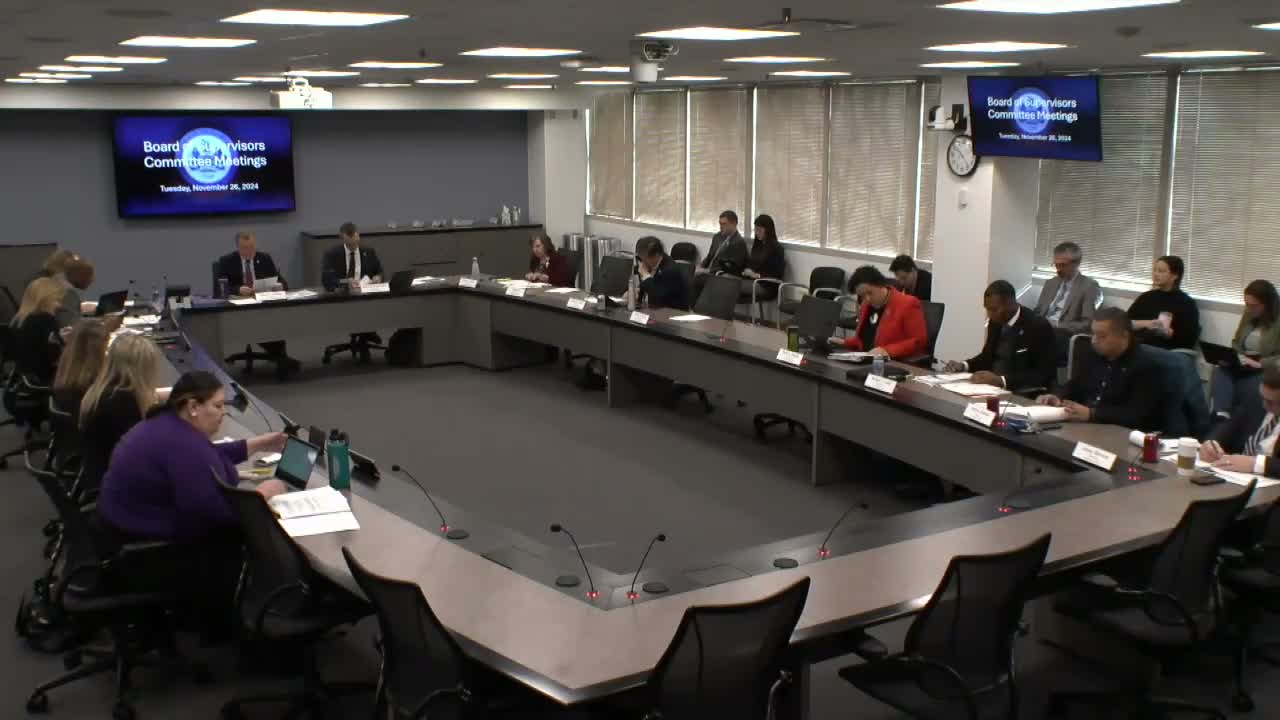
Fairfax County’s Legislative Committee on Nov. 26 recommended pursuing enabling legislation to allow a pilot that would deploy acoustic noise-monitoring devices to detect excessive vehicle exhaust noise.
Noel Dominguez summarized the history: statutory changes in 2020 reduced enforcement tools and a 2022 General Assembly action restored some primary-offense authority for aftermarket mufflers and authorized localities to regulate them, but subsequent legislative efforts to expand enforcement or to prohibit certain aftermarket devices have failed. New acoustic technologies—microphone-based devices placed adjacent to roadways—have been piloted in other jurisdictions, including Miami Beach, Montgomery County (Maryland), Knoxville, New York City and London.
Dominguez reviewed early data: Knoxville’s program captured thousands of excessive-noise events in a short time window and New York City issued over 300 violations during a six-month span; New York City data showed many violations came from large trucks and motorcycles. Fairfax staff recommended initiating legislation to amend the Virginia code so the county could implement a small pilot program using acoustic devices to test enforcement, operational challenges, and safety impacts.
Board members broadly supported the pilot but raised questions about scope and equity. The chairman said existing law already makes illegal modified exhausts above a decibel limit, but enforcement is difficult; he urged the pilot allow devices to be moved among locations so enforcement does not simply concentrate where the devices are permanently placed. Other supervisors warned against targeting a single neighborhood and emphasized that a successful pilot must produce replicable data across Fairfax’s diverse communities.
Members discussed technical and process challenges: state vehicle safety and emissions inspections currently do not include noise checks (inspection manuals expressly exclude noise consideration), and inspection stations and service providers have historically resisted additional inspection requirements. Members suggested exploring whether emissions-measurement machines or similar equipment could be repurposed for noise detection or whether the county can implement a mobile enforcement model that minimizes burden on private inspection stations.
Staff recommended language to pursue a narrowly scoped pilot and to coordinate with legislators to draft the enabling code change. The committee requested staff draft the bill language and to consider pilot mobility and data-collection methods before presenting the final language for consideration.