Get Full Government Meeting Transcripts, Videos, & Alerts Forever!
Get email alerts on the Traffic Safety topic
No spam. Unsubscribe anytime.
Fairfax staff proposes pilot to lower 25 mph streets to 20 under new state authority; supervisors argue for broader testing and equity screening
Summary
After HB 1071 gave Fairfax authority to reduce posted 25 mph limits, FCDOT proposed a 20 mph pilot on three roads, citing VDOT permitting requirements and examples from Falls Church and Portland; supervisors debated pilot size, equity screening and RTAP integration.
Fairfax County staff on Thursday outlined how the county could use recently granted authority under HB 1071 to lower posted 25‑mph streets to 20 mph in business and residential districts, proposing a small pilot to test effectiveness and implementation needs.
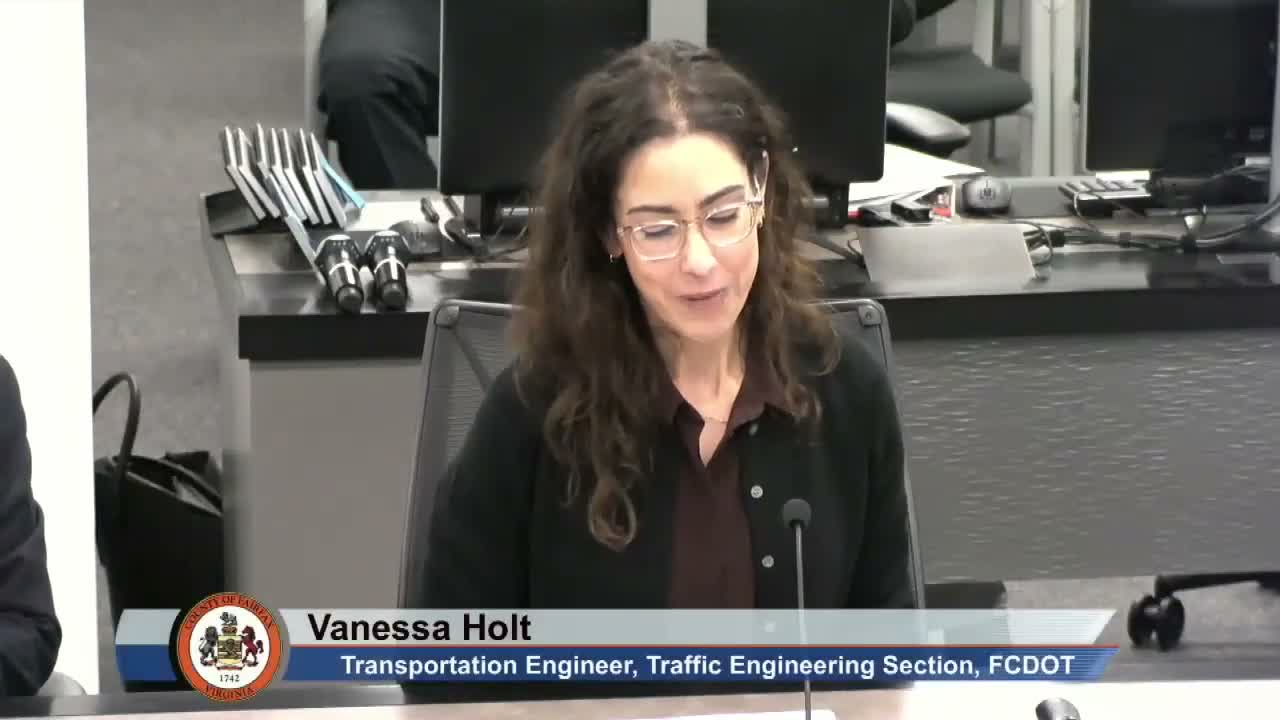
Vanessa Holt, a traffic engineer in Fairfax County DOT, said HB 1071 (enacted this July) allows the county to reduce posted 25 mph roads to below 25 mph — but not below 15 mph — for qualifying roads in business or residence districts. The county must adopt an ordinance and provide written notice to VDOT 30 days before a speed change; VDOT then reviews proposed sign locations, issues a locality reduced‑speed land use permit and records the change in the statewide database. Under current VDOT guidance the locality is responsible for procuring and installing any replaced or new speed signage.
Holt recommended a pilot targeting a 20 mph limit on three candidate roads that meet VDOT’s guidance (self‑enforcing roadway features, minimum segment length of ~0.2 miles, continuity with existing speed limits). She cited other jurisdictions: the City of Falls Church replaced about 100 signs at a cost of roughly $100,000 to reduce residential streets to 20 mph, and Portland reported reductions in average speeds on a majority of pilot sites.
Staff proposed screening candidate roads using a vulnerability index to incorporate equity considerations and asked board members to provide input on candidate selection, enforcement coordination with police, and whether the pilot should be embedded in the RTAP (Residential Traffic Administration Program) process. Neil Freshman (Fairfax County DOT) said existing RTAP staffing could be used for data collection and that the county could phase additional locations over time as capacity allows.
Supervisors debated pilot scale and priorities: several members said three roads would not capture Fairfax’s geographic diversity and asked for more sites across different roadway environments (quasi‑rural, industrial, high pedestrian). Others urged a problem‑driven approach — selecting streets with documented safety issues — and cautioned about competing staff resources. Multiple supervisors supported using pilot data to guide possible broader adoption or integration into RTAP.
No formal action was taken; staff will return with candidate roads and an implementation plan if the board approves a pilot in coming months.