Get Full Government Meeting Transcripts, Videos, & Alerts Forever!
Get email alerts on the Solid Waste topic
No spam. Unsubscribe anytime.
Survey finds majority support for countywide collection; supervisors back residential unified sanitary district and plan timeline
Summary
Fairfax County staff reported nearly 5,000 survey responses and strong community interest in a unified sanitary district; staff propose a residential-first implementation, a FY27 fee request of $10–$12 to seed programs, and DEQ submission targeted for April 2025 with public hearings in early 2025.
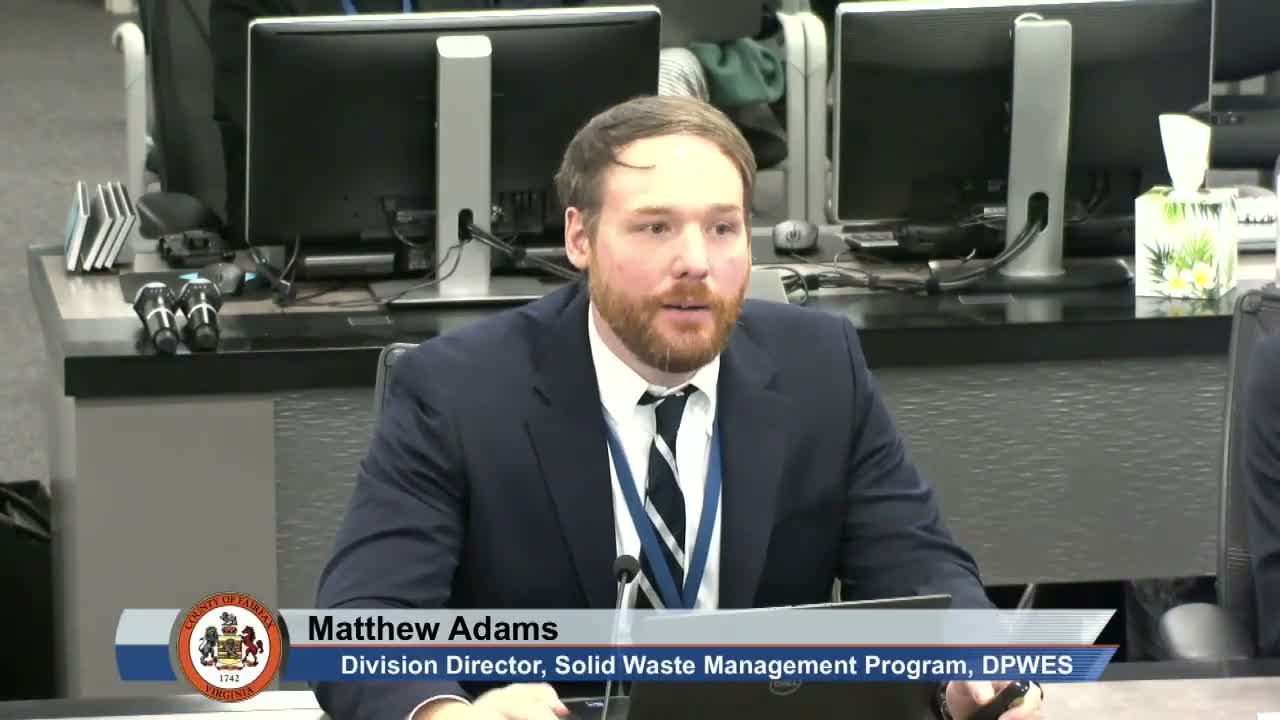
Matthew Adams of Fairfax County’s Solid Waste Management Program told the Environmental Committee the county’s public engagement campaign yielded nearly 5,000 completed surveys, more than 2,000 open comments and over 16,000 survey views, giving staff a substantial dataset to shape the 20-year solid waste plan.
Key public findings: Adams said 53% of respondents supported a countywide standardized (unified sanitary district) collection model to expand equal access to collection services and leverage economies of scale. He said 44% approved a pay-as-you-throw approach and that comparable countywide models in other jurisdictions reduced collection rates by roughly 25% in past examples. Adams also reported that, of 4,136 respondents to a willingness-to-pay question, 64% were willing to contribute a monthly amount toward sustainability and solid-waste initiatives, with an average of $38.64 per household per year. Staff are requesting a $10–$12 per household fee in FY27 to begin program initiatives.
Board discussion and equity concerns: Board members generally supported moving forward with a residential unified sanitary district while asking for more study on multifamily and commercial inclusion, service-level design and equity impacts. Supervisor Smith voiced specific equity concerns about pay-as-you-throw and urged careful design to avoid disproportionately affecting lower-income households. Several supervisors requested one-on-one briefings and more specific modeling on service levels, opt-out rules for association-served communities, and the costs of adding organics or other service elements.
Timeline: Adams said staff will present a draft plan to the Board in December 2024, ask the Board for authorization for a public hearing in January 2025, hold the public hearing in February 2025, and submit the plan to the Virginia Department of Environmental Quality by April 2025.
What comes next: Staff will return for further direction and for a December committee update with firmer proposals on scope, service levels and funding. Supervisors signaled broad support for a residential-first approach while reserving final decisions until staff provide more specific financial and equity analyses.