Get Full Government Meeting Transcripts, Videos, & Alerts Forever!
Get email alerts on the Ebooks topic
No spam. Unsubscribe anytime.
Fairfax librarians say ebook licensing limits access and strains budgets; supervisors urged to push for federal fix
Summary
At an Oct. 15 joint meeting, Fairfax County Public Library staff told the Board of Supervisors that ebook licensing—where titles are licensed, not owned—raises prices, limits availability and forces repeated purchases; supervisors discussed federal and state advocacy and local budget responses.
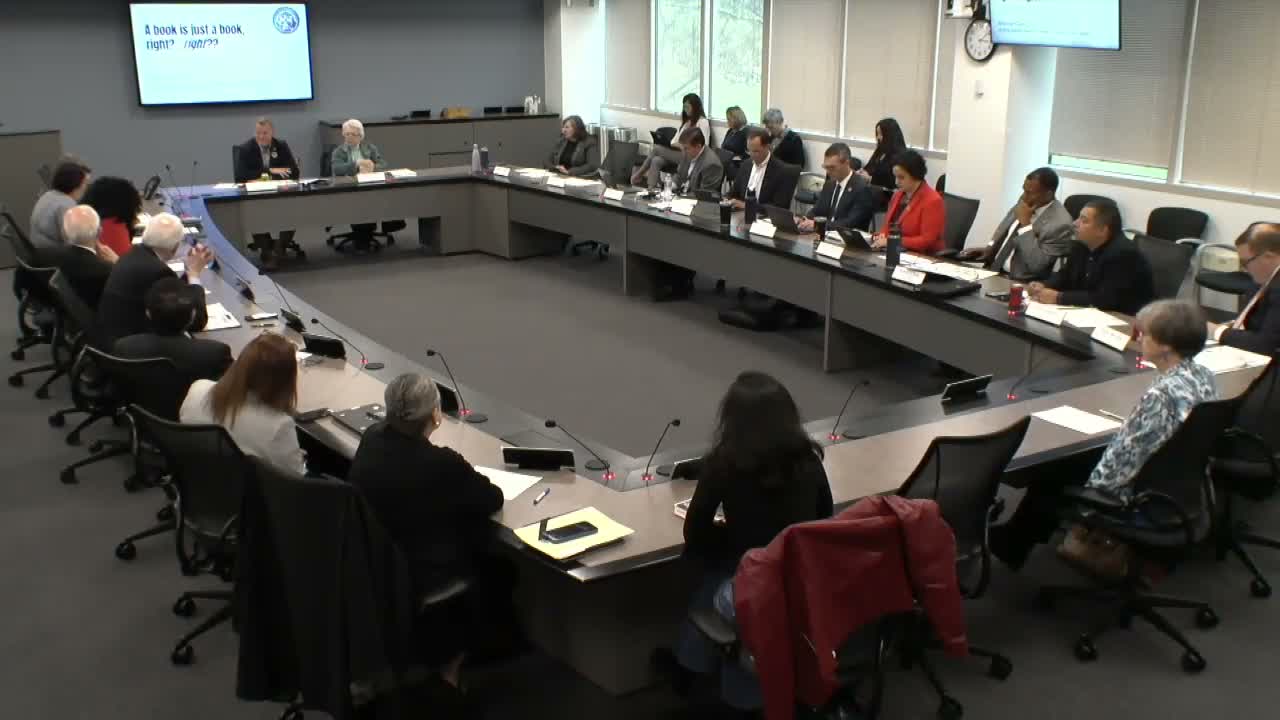
Diane Cohen, acting deputy director for Fairfax County Public Library (FCPL), told the Board of Supervisors in a Oct. 15 presentation that electronic titles are licensed rather than owned, a distinction that limits libraries’ ability to buy and maintain digital collections and drives higher costs for taxpayers.
"Electronic titles are not owned like traditional titles. Rather, they're licensed like software," Cohen said, adding that "First Sale doctrine does not apply to ebooks," so libraries cannot resell or permanently keep many digital formats. She outlined common licensing models — perpetual access, metered (12- or 24-month) licenses, cost‑per‑checkout and simultaneous‑use subscriptions — and described how each model affects circulation, cost and long‑term access.
Cohen gave specific examples to illustrate the gap between consumer and library pricing: a Kindle copy of Kristin Hannah’s The Women can be $14.99 while certain ebook licenses for libraries are priced as high as $60 and may require repurchase after 24 months. She said some cost‑per‑checkout titles can run more than $10 per circulation and that one model would have cost FCPL roughly $12,775 for a single high‑demand title in a recent year.
Supervisors asked what can be done at the state or federal level. Cohen described ongoing advocacy through the American Library Association and the Urban Library Council and said FCPL staff participate in an "ebook action committee" working with publishers and distributors. Several supervisors recalled past state efforts: Maryland legislation was overturned in federal court and New York measures were vetoed, and Senator Marsden introduced related language in Virginia’s General Assembly in 2023.
"The state by state approach also creates a challenge," said Supervisor Wauchenshaw, the Board’s legislative‑committee chair, noting that publishers could respond by choosing not to sell to libraries. "The federal level is probably the right place for this to be happening," Wauchenshaw said, while acknowledging political hurdles because copyright law changes are difficult in Congress.
On local budgets, Cohen said FCPL’s initial allocation for digital materials is about $1.2 million and that digital spending represents "a little over a third" of collections costs (one board member estimated roughly 42 percent). Supervisors noted that the board added a $500,000 increase for collection purchases in the most recent county budget and discussed whether further, longer‑term investments in digital content would be warranted.
Cohen and trustees also highlighted scale: FCPL reached 3,000,000 digital checkouts for the year in October, a milestone few systems hit. Trustees and supervisors urged continued outreach to members of Congress and coalition building with other large systems to press for broader policy changes.
The presentation closed with supervisors encouraging staff to keep the Board apprised of legislative options, and the meeting moved on to a trustees’ roundtable.
What happens next: FCPL staff said they will continue advocacy work through national library organizations and engage publishers, and supervisors indicated they may consider sustained budget support and federal advocacy as possible next steps.