Get Full Government Meeting Transcripts, Videos, & Alerts Forever!
Get email alerts on the Guaranteed Income topic
No spam. Unsubscribe anytime.
Fairfax County updates guaranteed-income pilot, cites early lessons on outreach and systems fit
Summary
Fairfax County staff updated the Health and Human Services Committee on an ARPA- and Innovation Fund–backed guaranteed-income pilot that provides 180 households $750 monthly for 18 months; researchers will report preliminary findings in spring 2025 and a final report in late 2025 or 2026.
Fairfax County officials told the Health and Human Services Committee on Oct. 15 that an ongoing guaranteed-income pilot is helping staff learn how direct cash payments fit into the county’s broader human-services system.
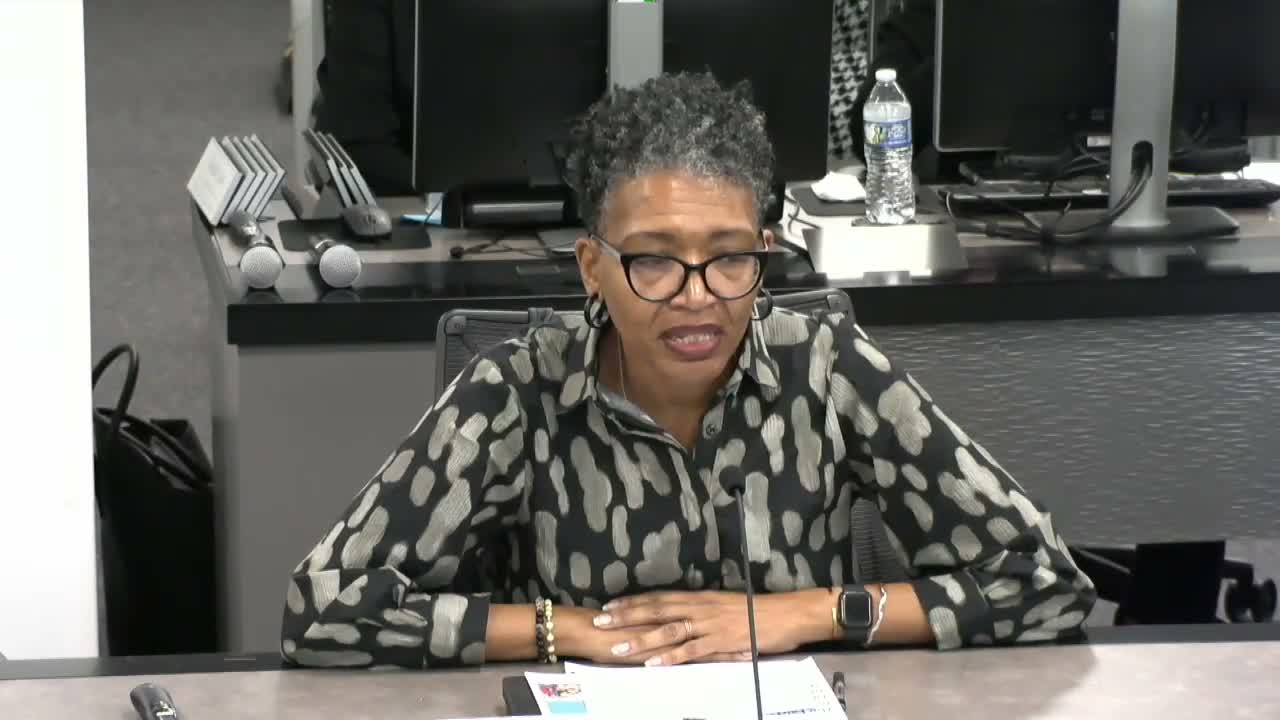
Carla Bruce, retiring chief equity officer, said the pilot launched in October 2023 and was funded through the county’s ARPA allocation and the Human Services Council Innovation Fund. "The pilot provided 180 randomly selected participants with a monthly cash payment of $750 for 18 months," Bruce said, and the payments were unrestricted so recipients could address the needs they judged most urgent.
The pilot targeted families in designated opportunity-neighborhood footprints who had at least one child under 16, were employed and fell into an ALICE (asset-limited, income-constrained, employed) band that United Way research estimates covers about 23% of Fairfax households. Bruce said staff received 2,400 applications, about 1,800 applicants completed eligibility steps, and 180 households were selected; the Department of Family Services administered eligibility with neighborhood partners handling outreach.
George Mason University’s Center for Social Science Research is evaluating the initiative. Bruce said the evaluation is not designed to test whether guaranteed income “works” in the abstract — that literature already exists — but rather to examine how a guaranteed-income model fits county programs and what design choices are needed locally. Researchers are examining family mobility trajectories, changes in social capital and how the pilot interacts with other county supports.
Board members focused questions on research design, program dates and access. A supervisor asked whether the study included a control group; Bruce said the county did not design the pilot with an internal control because the evaluation’s purpose is to surface design lessons, though she acknowledged that randomized-control results from other jurisdictions show measurable differences when controls are used. Bruce confirmed payments began in October 2023 and were recently extended to March 2025 to complete the 18-month payment period.
County staff described participant demographics: roughly 58% women, about 40% Hispanic/Latino, 25% Black, 7% identifying as having a disability; 73% preferred English and 22% requested Spanish-language communication. The pilot also pairs cash with wraparound supports and targeted outreach; staff said in-person assistance and a multilingual vendor platform helped reduce application barriers.
Bruce and supervisors emphasized that the pilot’s value is both the direct assistance and the systems lessons it yields. Bruce said preliminary findings will be ready for a spring 2025 committee update and the team expects a final report in late 2025 or spring 2026. She urged the board to consider philanthropic and private-sector partnerships if the county wants to sustain similar assistance beyond ARPA funding.
The committee did not take formal action on the pilot during the meeting; staff committed to return with preliminary evaluation results and additional follow-up information.