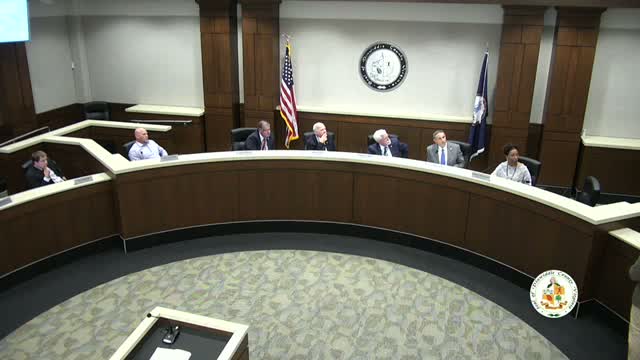
Dinwiddie supervisors reject proposed 20‑MW solar rezoning after hours of public comment
Loading...
Summary
After a lengthy public hearing with developers and neighbors, the Board of Supervisors voted to deny a rezoning request for a proposed 20‑megawatt solar project on roughly 228 acres; residents raised concerns about private road impacts, groundwater and decommissioning. 350 characters or less.
The Dinwiddie County Board of Supervisors voted unanimously Aug. 20 to deny a rezoning application that would have rezoned roughly 228 acres for a utility‑scale solar project and authorized a conditional use permit.
County planners summarized the applicant’s proposal as a roughly 20‑megawatt alternating‑current photovoltaic project, with about 94 acres of panel arrays and approximately 45 acres to be fenced. Staff described a 75‑foot vegetative buffer around the site, a wetlands avoidance plan that included an Army Corps‑approved delineation, and required submissions — including erosion‑and‑sediment control plans, a construction traffic management plan and a decommissioning plan — as conditions of any approval. Fiscal projections shown to the board included estimated machinery‑and‑tools taxes and an approximate revenue‑share figure presented in the staff packet.
The developer, represented by Robert White of Actualized Solar Power and Victor Slade Jr., described the project as distribution‑connected (not tied to transmission lines) and said it would produce grid resilience and power roughly equivalent to the needs of about 3,000 homes. White said the company would upgrade and maintain an existing private access road (Walker’s Pond Drive), post security for decommissioning and subject the site to groundwater testing that would be done quarterly in the first year and annually thereafter.
Multiple residents who live adjacent to the proposed site told the board they opposed the project, raising repeated concerns about heavy construction traffic and who would pay to upgrade and maintain the private road, the potential for runoff and impacts to private wells and Wallace Creek, and the effect on property values and rural character. One resident argued the county should “be a good neighbor” and not rezone land surrounding long‑standing homes for industrialized energy production.
In rebuttal, the applicant cited TCLP (toxic characteristic leaching procedure) tests and other studies and said manufacturers and recyclers accept end‑of‑life panels; the applicant also emphasized buffering and a decommissioning bond provision that would be adjusted every five years.
After discussion, a supervisor moved to disapprove the rezoning; the motion carried by roll call. Because the rezoning failed, the board did not take separate votes on the site agreement or the conditional use permit.
The denial means the applicant must either withdraw, alter the proposal and resubmit, or pursue other siting options; the county’s staff packet and the developer’s materials remain part of the public record.