Get Full Government Meeting Transcripts, Videos, & Alerts Forever!
Get email alerts on the University Of Baltimore topic
No spam. Unsubscribe anytime.
University of Baltimore tells subcommittee enrollment decline has slowed; prison and dual‑enrollment programs highlighted
Summary
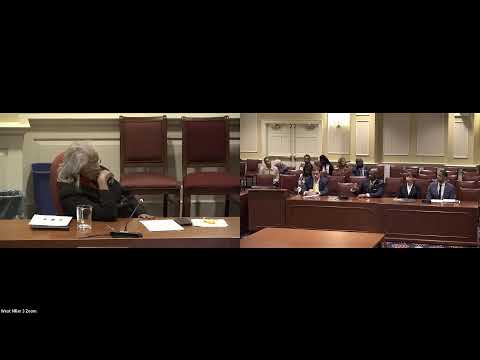
A Department of Legislative Services analyst told the Education, Business and Administration Subcommittee that University of Baltimore enrollment and institutional aid fell sharply during the pandemic but began to recover in 2023; university representatives emphasized a strategic shift toward graduate programs and described degree programs at Jessup Correctional Institution and dual‑enrollment outreach to Baltimore City high schools.
A Department of Legislative Services analyst reported to the Education, Business and Administration Subcommittee that the University of Baltimore’s first‑time applications fell from a 2017 high of 857 to about 298 in fall 2022 and that only 30 first‑time students enrolled that year. The analyst said the university’s acceptance rate and enrollment declined through 2022 but showed early signs of recovery in fall 2023, when applications rose 4.4% and enrollment grew by 31 students.
“Overall, the enrollment was down by 7% or 96 students,” the analyst told the subcommittee, noting the decline was primarily driven by continuing non‑returns of students and by pandemic effects on recruitment and in‑person events. The analyst also cited FAFSA simplification as a potential near‑term affordability risk, saying UBalt estimates about 38 students could lose Pell awards and that keeping those students whole would cost roughly $500,000.
Kurt Schmoke, representing the university, said the shift in student mix — from 51% undergraduate in the prior decade to roughly 41% undergraduate now — was intentional. “This is something we decided that the university should be… 60% graduate and professional, 40% undergraduate,” he said, describing UBalt’s focus on nontraditional and transfer students.
Schmoke highlighted two programs the university cites as recruitment and retention tools. He described the Jessup Correctional Institution degree program, noting that since 2016 UBalt has awarded degrees to 36 men and currently supports 46 students in the program. He credited faculty leadership and campus wraparound services for supporting participants after release.
On dual enrollment, Schmoke said UBalt runs summer courses on campus and a mixture of faculty, adjuncts and some high‑school teachers deliver courses during the academic year. The committee asked the university for a future written breakdown showing the mix of instructors and where classes are taught.
The analyst presented budget exhibits showing FY25 allowance changes: expenditures rose in some program areas due to salary annualization, while state funds were reported to decline about 4.5% in one presentation table. Institutional aid spending and unrestricted revenue composition were flagged as vulnerable to continuing enrollment shifts.
The subcommittee asked the university to provide additional detail on retention efforts, the scope and cost of mitigating FAFSA impacts and how dual‑enrollment staffing is allocated. The university said it had recently hired a Director of Admissions and fully staffed recruiting to support the early rebound in applications.