Get Full Government Meeting Transcripts, Videos, & Alerts Forever!
Get email alerts on the Land Use topic
No spam. Unsubscribe anytime.
Franklin County to hold evidentiary hearing after residents and magistrates challenge Keaton Lane industrial authority language
Summary
Facing sustained public opposition and questions about missing studies, Franklin County fiscal court voted to hold an evidentiary hearing on a request to rezone 24.45 acres at 827 Cardinal Lane and to further examine a state-required industrial-authority resolution.
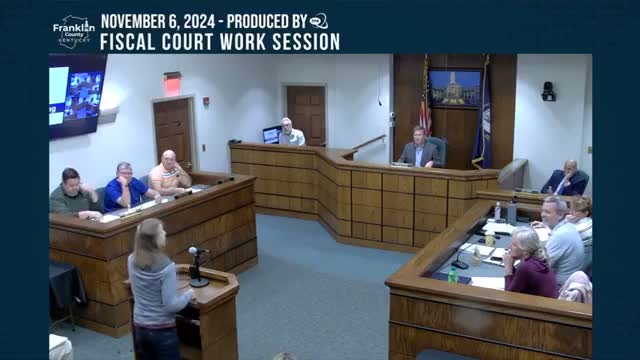
Frankfort — Franklin County fiscal court on Nov. 6 agreed to hold an evidentiary hearing on a contested rezoning request for roughly 24.45 acres at 827 Cardinal Lane after residents and several magistrates said they lacked sufficient information to decide from the planning commission record.
Judge (presiding officer) opened debate on the first reading of an ordinance to change the parcel from Rural Residential (RB) to Rural Low-Density Multifamily (RL). Ben, a planning staff member, told the court the planning commission closed its public hearing on Sept. 12 and that the court’s 90-day deadline for a decision would fall on Dec. 11. Several magistrates said key materials that would bear on the decision — including the planning commission’s explicit vote record, a traffic study and clear sewer-capacity analyses — were absent from the packet.
"The record references a traffic study multiple times, but I didn't see it in the documents we received," Squire Sebastian said, explaining his vote against deciding the matter on the planning commission record alone. Squire Westman calculated that, under the RL density formula, the parcel could yield a theoretical maximum of about 407 dwelling units and said that possibility raised questions about infrastructure and compliance with the county's comprehensive plan.
Members of the public, including Chris Schimler and Larry Arnett, urged the court to pause action and said the community repeatedly opposed locating an industrial park along the county line during the comprehensive-plan process. "You're not listening to the public," Schimler told the court, arguing that passing resolutions to advance property acquisition and an industrial authority would short-circuit the public-planning process.
County attorney Max warned that permitting public comments that present new evidence on an item already decided by the planning commission could pose due-process problems and invited legal challenges. Magistrates debated whether the court should rely on the planning commission’s record or hear new sworn testimony in an evidentiary hearing; the initial motion to base the decision solely on the planning record failed. The court later voted to conduct its own evidentiary hearing on the rezoning request.
Penny, the executive director working on the state PDI grant, also presented a state-required resolution naming Franklin County as grantee for phase 2 of the grant, which she said is a formality needed to advance due diligence for a potential Keaton Lane Regional Industrial Authority. Several magistrates pressed Penny on language in the draft resolution that reads like an existing authority and on who would make appointments; Penny responded that the authority is not yet formed and would require an interlocal agreement and subsequent approvals.
What happens next: the court set an evidentiary hearing to take testimony on the rezoning proposal rather than deciding based strictly on the planning commission record. No final zoning decision was made on Nov. 6; the hearing will create an additional official record the court can consider before voting.