
Peaks Mill Water District seeks options after steep losses, new rate orders and federal rules force tough choices
Get AI-powered insights, summaries, and transcripts
Subscribe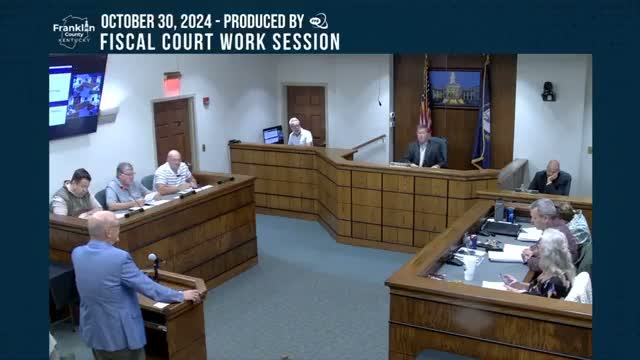
Summary
Peaks Mill Water District staff told Franklin County fiscal court that aging pipes, high water loss and new lead-and-copper requirements left the district facing a 21%–28% rate increase, potential consolidation options and a short window to stabilize finances.
Greg Heitzman, an advisor to the Peaks Mill Water District, told Franklin County fiscal court the small system is facing “existential” financial pressures caused by aging infrastructure, high leakage and rising regulatory costs.
Heitzman said the district’s nonrevenue water loss is about 25% and that when flushing—the routine work required to keep chlorine residuals stable—is included, the total nonrevenue water reaches roughly 45%. A recent cost-of-service study Heitzman helped arrange recommended a rate increase of about 21%; the Kentucky Public Service Commission’s analysis recommended roughly a 28% increase. “We’ve gone from roughly a $48 per month average bill for 4,000 gallons to over $60,” Heitzman said, describing one example of the immediate customer impact.
The presentation outlined three broad paths: continued operation as a standalone district with higher rates and targeted projects; shared services or formal consolidation with nearby systems to gain economies of scale; or acquisition by a larger utility. Heitzman said Kentucky American Water has expressed interest in acquisition in the past and that consolidation could open eligibility for state grant and low‑interest loan funds that are being targeted at troubled systems.
Court members pressed Heitzman on compliance steps required under the Lead and Copper Rule. Heitzman said the system must complete a service-line inventory and notify customers with unknown service-line materials; he said roughly 630 customers will receive letters indicating the material is unknown and that federal rules will treat unknown lines as if they were lead for regulatory purposes. He warned that complying with sampling and excavation requirements will add costs: Heitzman estimated a program to excavate and verify a 20% sample of unknown lines could cost roughly $60,000–$70,000 for Peaks Mill.
Heitzman described the district’s recent financial trajectory: operating losses of roughly $14,000–$17,000 per month on a budget of about $750,000 over recent years have eroded reserves, and without higher rates or new revenue the district risked default in subsequent years. He said the board retained Kentucky Rural Water and conducted a rate study that showed the need for an increase; the PSC issued its order on Sept. 4.
Heitzman and court members discussed the mechanics of consolidation and acquisition. Heitzman said consolidation could allow a larger fund to subsidize necessary upgrades while equalizing rates over time, and that the Public Service Commission has the authority to order a merger if a board fails to act—though that is relatively rare. He recommended the board consider surcharges dedicated to water-loss reduction and pursue grants or partnerships that could provide the economies of scale small systems lack. “As a stand‑alone entity, Peaks Mill Water District is not financially feasible long term,” Heitzman said.
Next steps recorded in the discussion included further public meetings, exploration of shared services with neighboring systems such as Elkhorn and Farmdale, continuing to monitor federal funding opportunities, and using the rate increase to stabilize cash flow while the board pursues longer-term solutions.
The court did not take a formal vote on the water district’s recommendations during this work session; Heitzman’s presentation concluded with a pledge to continue outreach and to bring more specific project proposals back to the district and the court.