
Firm pitches countywide energy‑savings plan, including jail solar and roof replacement
Get AI-powered insights, summaries, and transcripts
Subscribe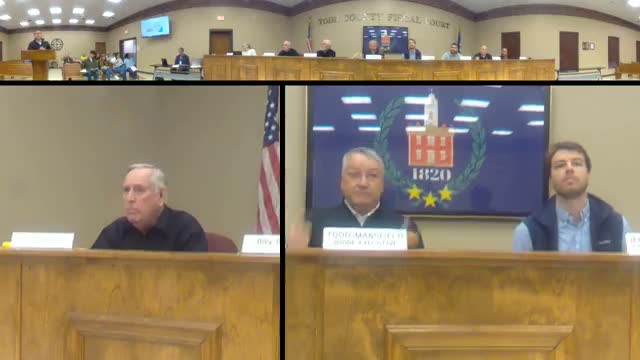
Summary
Presenters from Ascendant Facilities Partners told the Todd County fiscal court they can fund LED, HVAC tuneups and solar projects across county buildings using guaranteed savings and federal tax credits; the court asked for a final contract and a decision at its next meeting.
Presenters from Ascendant Facilities Partners outlined a countywide energy‑savings proposal at the Todd County fiscal court meeting, offering LED lighting upgrades, plumbing and HVAC tuneups, a jail roof replacement and rooftop solar arrays intended to be financed from the guaranteed energy savings the project would generate. A presenter described the approach as a consolidated package that “moves money that’s in your budget currently back into your facility,” and said the company models savings conservatively so the county sees most of the operational benefit.
The proposal covers multiple county buildings and would use a guaranteed energy savings contract (GESC) or other public finance vehicle. The presenter explained that the federal Investment Tax Credit under the Inflation Reduction Act now allows certain public entities in energy communities to receive a 30% direct pay on renewable installations. “Everybody that puts solar on a building right now is gonna get 30%,” the presenter said, adding AFP will help the county file for direct pay and utility rebates.
AFP emphasized that some measures — lighting, HVAC rejuvenation and geothermal loop maintenance — can start quickly, but solar installation on the jail depends on replacing a roof the company found to have moisture in core samples. The presenter said the recommended roof replacement would meet current energy‑code insulation values, add two and a half inches of insulation and be finished with a white reflective surface; the chosen roof warranty would be 30 years and solar panels carry a 25‑year warranty. The firm estimated the proposed solar array would supply about 35–40% of the jail’s electricity depending on the season and noted switching two electric rooftop units to natural gas would increase that share.
Court members asked technical questions about warranties, battery backup and project sequencing. AFP said batteries are not included in the initial scope but the system will be configured to add battery storage later; inverters have a roughly 12‑year warranty and batteries currently have a shorter life cycle. AFP described project accountability: once the scope and price are set in the GESC model there would be no change orders and AFP would manage installation, warranty claims and ongoing performance.
Judge Todd asked the court to reach a decision by its next session because of timelines tied to the tax credit and the roofing schedule; AFP said it would finalize scope and contract language after fiscal‑team review and provide a single point of contact for weekly coordination during heavy construction phases. The court did not vote on the contract at the meeting and requested the firm return with a finalized proposal and clarifications for formal consideration.