
Utah Court of Appeals hears novel dispute over when a district-court termination of parental rights is appealable
Get AI-powered insights, summaries, and transcripts
Subscribe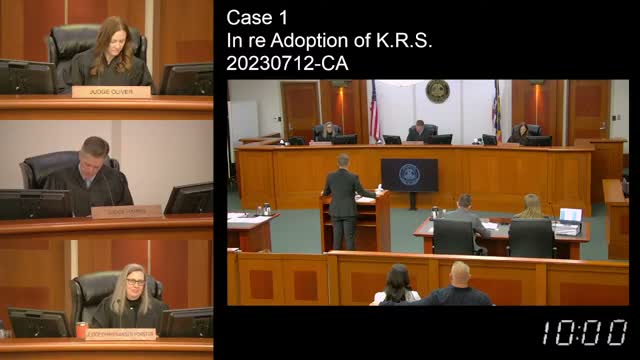
Summary
At oral argument the court considered whether a district-court order terminating parental rights in an adoption proceeding is immediately appealable or must await a final adoption decree or Rule 54(b) certification; counsel disagreed about notice, default, and sufficiency of best-interest findings. The panel took the matter under advisement.
SALT LAKE CITY — The Utah Court of Appeals on Halloween heard argument in an appeal that asks whether a district court order terminating parental rights in an adoption case is immediately appealable or whether the parent must wait until a final adoption decree or obtain interlocutory certification under Rule 54(b).
Jason Richards, counsel identified in the record as representing the father, told the three-judge panel that the Adoption Act contemplates that "an order terminating parental rights" can be a "final and appealable order," and argued the statute should be read to allow an immediate appeal when parental rights have been terminated. Richards said treating the termination as immediately appealable is necessary because, after termination, a parent "is no longer entitled to notice" and may lose appointed counsel, which can leave the parent without an effective avenue to challenge the order if an adoption later fails to proceed.
Opposing counsel Mark Nelson, who identified himself as representing the adoptive mother and stepfather, urged that the appeal is premature. Nelson said the district court process and the Adoption Act differ from juvenile-court proceedings and that allowing immediate appeals from a termination order in district court would require either explicit statutory language or interlocutory certification, such as Rule 54(b). Nelson likened the statutory language to a bifurcated divorce decree, arguing that appeals ordinarily await resolution of all claims between all parties.
The panel repeatedly pressed both sides to reconcile competing authorities. Counsel and the judges discussed prior Supreme Court decisions referenced in argument as BH and CC. Richards said BH focused on UCCJEA jurisdiction and supported treating a termination as final; Nelson and the court pointed to CC as a decision that distinguished finality questions in district-court contexts. The judges noted that some statutes expressly permit appeals from particular nonfinal orders but that the Adoption Act lacks such express interlocutory-appeal language.
The court probed practical consequences. One judge posed a scenario in which an adoption petition later fails: how would a terminated parent know to appeal if adoptions are sealed and the parent no longer receives notice? Counsel answered that counsel of record can continue to receive electronic notifications unless withdrawn, but acknowledged this may not fully remedy the problem when records are sealed and the parent has no counsel.
The panel also examined whether the father's default in the district court was procedurally proper. Counsel debated whether pleadings were formally stricken or whether the proceedings more closely resembled a one-sided bench trial in which the court made findings based on affidavit and records after the father ceased cooperating. Richards argued the district court's final order was deficient on the child's best-interest findings and that the record did not adequately support termination as a matter of law.
Judges asked whether recognizing immediate appealability in district court would require the appellate court to write new law or instead apply existing final-judgment principles used in juvenile-court cases. Counsel said the issue may be one of first impression in the appellate courts and urged the panel to consider both statutory text and the practical stakes involved, calling termination appeals matters that touch fundamental parental rights.
After closing arguments, the panel thanked counsel, called the dispute "very interesting," and said it would take the matter under advisement and issue a decision in due course. The court then adjourned.
The case is captioned in the argument as an adoption-related appeal and was identified in argument by case number 20230712; counsel listed in the record included Jason Richards and Alexander Marshall for the father and Mark Nelson and Jessica Anderson for the adoptive parents. The panel identified itself at the start of argument as Judges Ryan Harris, Michelle Christensen Forster and Amy Oliver.
Next steps: the Court of Appeals will issue a written decision. No vote or formal ruling was announced from the bench at the hearing's conclusion.