Get Full Government Meeting Transcripts, Videos, & Alerts Forever!
Get email alerts on the Environmental Law topic
No spam. Unsubscribe anytime.
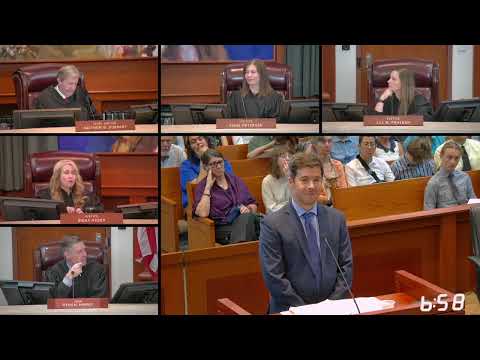
Utah Supreme Court hears youth challenge to statutes directing fossil-fuel development
Summary
The Utah Supreme Court heard oral argument in Roussel v. State, where youth plaintiffs say statutes that direct state agencies to promote fossil-fuel development violate their constitutional rights to life, health and safety; justices probed redressability, ripeness and whether declaratory relief can provide meaningful remedies.
The Utah Supreme Court heard argument in Roussel v. State, a youth-led constitutional challenge alleging that state statutes directing the promotion and authorization of fossil-fuel development harm the plaintiffs’ health and life expectancy.
Andrew Welly, counsel for the youth plaintiffs, told the Court that "Utah's fossil fuel laws are causing serious harms to their personal health and safety and taking years off of their lives," and urged reversal of a dismissal so the claims can proceed to factual development. Welly framed the relief sought as declaratory: a judicial pronouncement that the statutory directives are unconstitutional that would, he said, "fundamentally change the legal landscape" and provide defendants guidance going forward.
Justices pressed Welly on redressability and ripeness. One justice questioned how a declaratory judgment—without injunctive relief—would alter any specific future permitting decision, noting the Court would not be "writing our own policy" to require opposite outcomes. Welly responded that a declaration that statutes are unconstitutional, together with findings of fact and conclusions of law on remand, would create constitutional constraints and standards (including an application of strict scrutiny) for agency decisionmaking and could lead to different permit outcomes.
Welly relied on precedent, citing this Court’s Spackman decision and analogues such as Health v. Montana to argue that declaratory relief and systemic findings have previously guided governmental conduct. He also cited institutional‑reform and systemic‑conduct cases (including references to Kuchinski, Croson, Brown v. Board of Education and Brown v. Plata) to support the proposition that constitutional violations can arise from a course of governmental policies and practices rather than a single discrete agency action.
The plaintiffs’ complaint, Welly told the Court, contains factual allegations intended to show ongoing, systemic government conduct and its effects; he pointed to complaint paragraphs that allege defendants "to date have issued permits authorizing the extraction of roughly 2,000,000,000 barrels of oil, 14,000,000,000,000 cubic feet of natural gas, and nearly 1,000,000,000 tons of coal." He characterized Utah’s notice‑pleading standard as permissive and said detailed permit lists are more appropriately developed through discovery.
A justice asked whether the state was disputing causation between the statutes and development or merely attacking the specificity of the pleading; Welly characterized the state’s argument as closer to a pleading‑standards objection and said that if the Court found the complaint deficient the appropriate remedy would be remand for amendment rather than an affirmance of dismissal.
The panel also asked about recent statutory revisions raised by the state’s briefing. Chairman Bryant noted language in a recently revised statute read aloud in court that the State will develop energy resources "with a focus on human well‑being and quality of life" and refers to promoting a diverse energy portfolio. Welly said the amendment was largely structural and that an express directive to promote fossil fuels remained in a restructured subsection; he said the plaintiffs could amend to identify the new subsection if the case is remanded.
No final ruling was announced in the portion of the argument covered by this transcript excerpt. The Court’s questions focused on whether declaratory relief alone can satisfy redressability and whether the complaint contains sufficient factual allegations to show an ongoing, systemic policy that causes the harms alleged.
What happens next: if the Court allows the claims to proceed, the case would return to the district court for fact‑finding on emissions, localized air quality and the asserted impacts on the plaintiffs’ health and life expectancy; if the Court affirms dismissal, the suit would end unless further pleadings or appeals follow.