Get Full Government Meeting Transcripts, Videos, & Alerts Forever!
Get email alerts on the Right To Life Declaratory Challenge topic
No spam. Unsubscribe anytime.
Utah Supreme Court hears challenge that state fossil‑fuel policies endanger youths’ lives; justices press redressability limits
Summary
At oral argument plaintiffs said state statutes and policies promoting fossil‑fuel development are causing present harms that shorten youths’ lives; the State countered that plaintiffs seek a sweeping declaratory ruling that would be advisory and not redressable absent a concrete agency action or permit challenge.
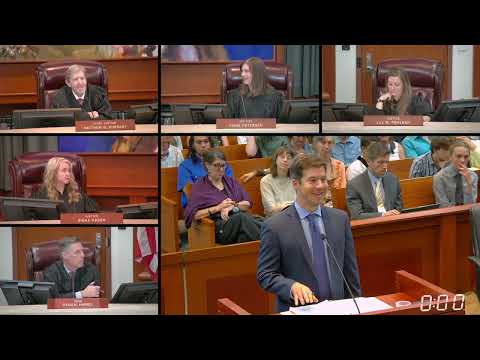
In a heated oral argument before the Utah Supreme Court, lawyers for youth plaintiffs argued that state statutes and policy statements promoting fossil‑fuel development create "pervasive, inescapable" conditions that are taking years off the lives of children exposed today, and asked the justices to reverse a lower court’s dismissal and remand for factual development.
A Justice pressed plaintiffs’ counsel on the contours of the asserted right to life, asking whether the alleged shortening of life must be immediate and certain to rise to constitutional stature. Plaintiffs’ counsel replied that the harms are occurring now and that scientific proof of lifespan reduction will emerge at trial, invoking prior decisions (for example, League of Women Voters) and historical sources to support recognizing fundamental rights without fixing numerical boundaries at the pleadings stage.
Erin Middleton, arguing for the State, urged the court to affirm dismissal. "Any relief . . . would amount to an advisory opinion," she told the bench, saying the plaintiffs attack broad policy statements that do not by themselves direct a particular permitting decision and that, even if those policy statements were struck, the agencies would still operate under other statutory frameworks. Middleton warned that a declaration of the kind plaintiffs seek would invite long‑term judicial oversight of routine permitting choices.
Justices probed both sides with hypotheticals. One asked what would happen "on the ground" if plaintiffs won everything: would the State be able to grant permits at all? Counsel for the plaintiffs said a declaration recognizing a constitutional restriction would require agencies to analyze emissions and deny permits when necessary to avoid substantial harm, while acknowledging that a transition would not halt development overnight.
The State emphasized justiciability and redressability. Middleton highlighted that the complaint does not identify specific agency actions or a particular permit to challenge and noted that one coal statute cited by plaintiffs mirrors a federal coal mining regulation, which raises additional implementation and federal‑consistency concerns.
Plaintiffs closed by pointing to allegations in their complaint quantifying statewide authorizations: more than 2,000,000,000 barrels of oil, 14,000,000,000,000 cubic feet of natural gas, nearly 1,000,000,000 tons of coal, and over 3,000,000,000 metric tons of carbon pollution. They asked the court to reverse the dismissal and permit discovery and a full factual record to determine whether constitutional rights are being violated.
The court took the arguments under advisement and moved to the next case. No opinion or decision was announced from the bench at the hearing’s close.