Get Full Government Meeting Transcripts, Videos, & Alerts Forever!
Get email alerts on the Bail And Pretrial Detention topic
No spam. Unsubscribe anytime.
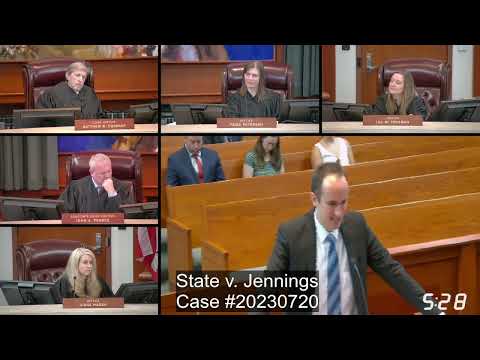
Utah Supreme Court hears challenge over whether state must disprove self‑defense to deny bail in State v. Jennings
Summary
At oral argument in State v. Jennings, counsel disputed whether the State must disprove a defendant’s claim of self‑defense at a bail hearing and whether the prosecution met the "substantial evidence" standard needed to deny bail. The court took the case under advisement.
At oral argument in State v. Jennings, the Utah Supreme Court heard competing views about the reach of the constitutionally protected right to bail and what the State must prove to deny it. "The right to bail is a fundamental right," petitioner’s counsel Eric Grange told the court, arguing that to deny Jennings the opportunity to post bail the State must present "substantial evidence of the alleged offense" that justifies pretrial incarceration. Grange told the court the State failed to present substantial evidence of mens rea and that the record raised self‑defense questions the State did not disprove.
Emily Safra, arguing for the State of Utah, urged the court to affirm the lower courts, saying the State presented evidence sufficient to justify continued detention. Safra summarized the prosecution's account of events, saying Jennings "then stabbed him twice, leaving 3 inch and 5 inch deep wounds in him." She told the court the record included preliminary‑hearing testimony and proffers that supported the charge and the decision to deny bail.
Justices pressed both sides about the applicable standard. Several questioned whether the "substantial evidence" test at a bail hearing collapses into the directed‑verdict or sufficiency standard used at trial or whether a district judge should weigh competing proffers and defense evidence at bail. One justice asked why a second strike by the defendant would not allow a jury to infer intent; another pressed whether an "incontrovertible" videotape of self‑defense would effectively bar detention at the bail stage.
Counsel also debated the role of justification hearings and statutory remedies: Grange noted that Jennings has a separate justification proceeding pending and emphasized that a successful justification hearing would dismiss charges, while bail relief only permits release on bond. The parties and bench discussed whether proffers made to the district court should be treated as evidence and how judges should assess credibility when hearings rely heavily on proffered rather than live testimony.
The court asked detailed questions about precedent and constitutional history, including citations to Randolph, Lopez, and earlier interpretations of the State's bail provision. The bench also focused on statutory language cited by the parties (the bail statute and Article I, §8 of the Utah Constitution) and whether the word "charge" in the constitutional text requires consideration of elements or defenses. Counsel disputed factual characterizations in the record, including whether certain prosecutor statements were supported by the preliminary hearing evidence.
After extended oral argument and questioning, the bench said it would take the matter under advisement. No decision was announced from the bench at the hearing.