Get Full Government Meeting Transcripts, Videos, & Alerts Forever!
Get email alerts on the Data Privacy Act topic
No spam. Unsubscribe anytime.
Utah Supreme Court weighs whether state officers circumvented Data Privacy Act by using federal subpoenas
Summary
At oral argument in State v. Andress, defense counsel argued Clearfield officers bypassed Utah's Data Privacy Act by obtaining federal administrative subpoenas for TextNow and Snapchat records instead of the state court order the statute requires; the State countered that federal subpoenas obtained through an FBI task force were valid and constitutional. The court took the case under advisement.
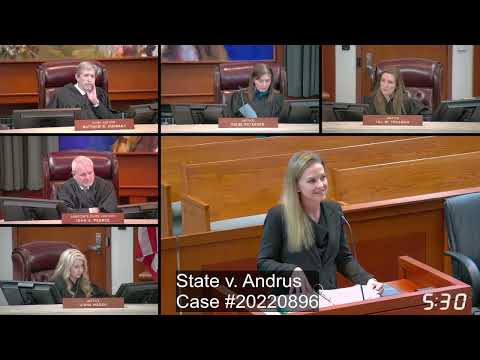
The Utah Supreme Court heard competing views Monday over whether state law enforcement violated the Utah Data Privacy Act by using federal administrative subpoenas to obtain subscriber records in State v. Andress.
Defense counsel, who identified themselves in the record as Sharice Bukalski and Emily Adams for defendant Dustin Andress, told the justices the case is "very simple, clear cut" under the statute: when a Utah law enforcement agent seeks subscriber or customer information from an electronic communication service provider, the Act requires prosecutor review and a Utah court order under section 77-22-2.5, and evidence obtained in violation of those procedures must be excluded under section 105. Bukalski argued Officer Carlson, a Clearfield Police Department member of a joint FBI task force, used the federal subpoena route instead of the mandatory state process and thereby triggered exclusion of the records and all derivative evidence.
"If they don't get that court order, that state court order signed off by a state prosecutor, then the evidence is excluded," Bukalski said during argument. She told the court the record shows the investigation "stayed with the Clearfield Police Department" and that, aside from a signature on a subpoena, the federal component did not convert the process into a bona fide federal investigation.
The State, represented by Jonathan Bauer, disputed that reading. Bauer said the subpoenas were issued through the FBI task force and that, if federal subpoena authority was properly invoked, their return would be valid under the Fourth Amendment and not subject to exclusion on that basis. He urged the Court to apply an objective test to assess whether the federal process was a valid exercise of federal authority and noted contemporaneous testimony in the record showing FBI involvement in the task force.
Justices pressed both sides on hypotheticals the opinion could affect: whether a state officer who asks the feds to issue subpoenas violates the statute the moment the request is made; whether records first obtained by federal investigators in an independent federal probe and later shared with state authorities would be excluded; and whether the statute's plain language or legislative history controls. Defense counsel emphasized the Act's definitions of "law enforcement agency" and the explicit procedures in chapter 22, while the State argued a plain reading of the statute in context and its legislative history supports cooperation with federal partners and counseled against an interpretation that would produce "absurd" consequences for common task-force practice.
The justices also focused on remedy. Defense counsel argued for exclusion under Section 105 without a traditional prejudice or harmlessness inquiry, pointing to Utah precedent where the remedy for certain state-constitutional violations has been suppression and remand without assessing harmlessness. The State urged the Court to consider harmless-error doctrines where appropriate and to distinguish statutory from constitutional claims.
The argument included factual probing about who prepared and signed the subpoenas (an FBI administrative assistant and a Supervisory Special Agent, Dustin Grant) and what information the subpoenas returned (counsel for the defense told the Court the returns included IP addresses, subscriber names, addresses and phone numbers). Counsel and justices debated whether those returns fell within the Act's definition of "subscriber record" and what statutory exceptions, if any, allow a state actor to receive records initially obtained through federal administrative subpoenas.
The Court did not rule at argument. After hearing both sides and asking extensive follow-up questions, the justices took the matter under advisement.