Get Full Government Meeting Transcripts, Videos, & Alerts Forever!
Get email alerts on the Amendment D Ballot Language topic
No spam. Unsubscribe anytime.
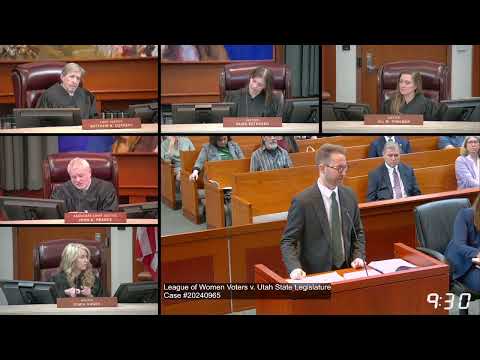
Utah Supreme Court weighs challenge to Amendment D ballot language and publication
Summary
At oral argument, plaintiffs told the Utah Supreme Court Amendment D’s ballot summary omits that the Legislature could repeal voter initiatives and that the Legislature failed to satisfy the Constitution’s publication requirement; defendants urged narrower relief so voters could decide the measure.
Salt Lake City — The Utah Supreme Court on Wednesday heard arguments in a dispute over Constitutional Amendment D, focusing on whether the ballot summary is misleading and whether the Legislature complied with the state Constitution’s publication requirement.
Mark Gaver, counsel for the plaintiffs-appellees, told the justices that Amendment D would allow the Legislature to repeal voter initiatives — a power he said the ballot summary omits and that a reasonable voter would not expect. “No one looking at this ballot language would understand that to be the operative effect of the amendment,” Gaver said, arguing the omission is both misleading and counterfactual.
Gaver also argued the Legislature failed to meet Article 23, Section 1’s publication mandate. He said the Legislature changed how voter materials are distributed, moving much material online, and that the full text of the proposed amendment was not continuously published in newspapers for the two‑month period the Constitution requires. He told the court many voters, who receive ballots by mail, will see only the short ballot language and not the full constitutional text or surrounding materials.
At issue are two connected claims: whether the ballot summary is objectively misleading as compared with the amendment’s text, and whether the Constitution’s publication clause was followed so that voters in fact had access to the full proposed language. The plaintiffs contend the district court properly concluded the combination of misleading language and deficient publication justified an injunction that the amendment not be submitted to voters and that votes not be counted.
Several justices probed the governing standard for reviewing ballot language. Gaver urged the court to apply an objective, reasonably intelligent voter test and to compare the ballot language to the amendment’s text, saying that courts are capable of determining whether the text is accurately portrayed. Defense counsel, briefing for the Legislature, had urged a stricter test focused on whether the ballot summary is simply contrary to the amendment itself.
The parties also disputed possible remedies. The Court asked whether a narrowly tailored injunction requiring additional publication could fix the problem before ballots are mailed. Gaver said no: the Constitution requires two months of publication and that timing and procedural constraints make a short‑term cure infeasible. He added that the Legislature had previously told the district court that the appropriate remedy would be voiding the amendment and not counting votes, and that defendants had not requested a narrower remedy below.
Counsel for proponents of the amendment — identified in argument as Ms. Meehan — urged the Court to vacate or narrow the injunction so voters may cast ballots. Meehan argued precedent on substantial compliance and practical remedies could support allowing the election to proceed with additional notice; she also said the voter information pamphlet and the lieutenant governor’s website would include the full text and for/against arguments in mid‑October.
The hearing covered the interplay between proposed statutory language (cited in briefing as SB 4,003 and SB 4,002), the text of Amendment D, and the Court’s prior League of Women Voters decision that left open questions the amendment seeks to answer. Counsel disagreed about whether the amendment genuinely ‘clarifies’ the law governing initiatives or instead eliminates a protection for voter‑initiated government reform by enabling repeals.
The justices did not announce a decision from the bench. The district court had entered a preliminary injunction voiding the amendment and directing that votes not be counted; the Supreme Court’s ruling will determine whether that injunction stands or is narrowed to allow the election to proceed.
The argument concluded with counsel for both sides reiterating that the issues are of statewide significance and the Court adjourning without issuing an immediate decision.