Get Full Government Meeting Transcripts, Videos, & Alerts Forever!
Get email alerts on the Election Procedure topic
No spam. Unsubscribe anytime.
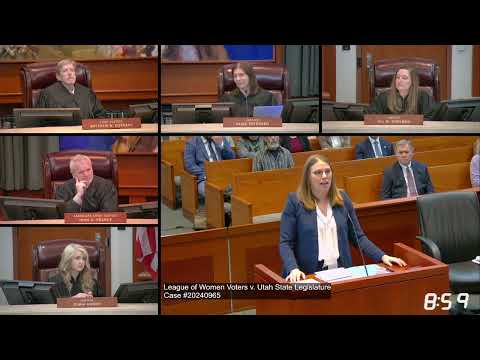
Utah Supreme Court hears arguments over Amendment D publication and ballot summary; state urges narrowing injunction
Summary
At oral argument in League of Women Voters v. Utah State Legislature, the state urged the Utah Supreme Court to vacate or narrow a district-court injunction that prevents votes on Amendment D from being counted, arguing modern online publication and surrounding materials satisfy Article 23 notice requirements and that any defects can be cured by tailored relief rather than canceling the election.
The Utah Supreme Court heard extended argument over whether Amendment D may remain on the 2024 ballot after plaintiffs persuaded a lower court to enjoin the vote. Counsel for the Legislature told the Court plaintiffs "obtained a statewide mandatory injunction ordering that no Utahns' votes be counted," and asked the justices to either vacate that injunction or narrow it so voters can decide the amendment.
The state argued that Article 23's publication and submission requirements should be understood in light of modern practices. "If you disagree with me on that, then I think the clock starts the week of September 16," counsel said, describing a hard-copy legal notice that ran that day and the Legislature's purchase of legal-ad space through the Utah Press Association cooperative. Counsel told the Court some newspaper notices appear online continuously and that the Legislature also made the full amendment text available on the Legislature's website and related bill pages.
The bench pressed two central legal questions: whether the constitutional word "newspaper" requires hard-copy publication over an eight-week period, and whether the ballot summary accurately presents the amendment. Several justices questioned whether online republication, hyperlinks to an online bill file and press coverage satisfy the publication clause's notice principle; other justices emphasized the framers' choice to require publication in newspapers and asked whether that command should be treated as mandatory.
Counsel urged the Court to apply a substantial-compliance approach adopted in other jurisdictions: even if the Legislature did not strictly meet an eight-week publication rule, the Court could require supplemental publication in the weeks remaining before the election rather than nullifying the vote. Counsel said that, given time left before the election, a narrower equitable remedy could cure any publication shortfall.
The justices also zeroed in on the ballot summary's wording. Plaintiffs contend the summary is misleading; the state responded that the summary "identifies" the amendment and surrounding materials (voter information pamphlets, the full text on official websites, press coverage) inform what a reasonably intelligent voter would understand. The Court debated the meaning of the word "clarify" in the summary and whether that verb implies mere explanation or a substantive change in rights and authority.
Argument also considered the amendment's practical effects on the initiative process. Counsel noted that passage of Amendment D would interact with legislation (counsel identified a trigger of "SB 4003") and could change the way courts or the Legislature treat citizen initiatives; several justices pressed whether the ballot materials adequately notify voters of those consequences.
The Court paused for a recess after extensive questioning. No opinion or ruling was announced during argument; the high court will take the matter under consideration.
Authorities and procedural posture cited during argument included Article 23 of the Utah Constitution (publication and submission of amendments), Article 1 Section 2 (initiative rights), references to 1970s Utah statutes governing publication frequency, the Utah Press Association cooperative, and out-of-state precedents discussed by counsel (Nowers, Snow, Dutton, Morgan, and other cases raising the substantial-compliance doctrine). The district-court preliminary injunction remains in place pending the Court's resolution.