Get Full Government Meeting Transcripts, Videos, & Alerts Forever!
Get email alerts on the Self Defense Pretrial topic
No spam. Unsubscribe anytime.
Utah Supreme Court considers whether a proffered self‑defense claim suffices at a pretrial justification hearing
Summary
At oral argument, defense counsel said a prima facie self‑defense claim may be met by a proffer of facts assumed true; the State countered that the statute and precedent require some evidentiary showing and that death resulting from force may place the case in the lethal‑force category. The court took the case under advisement.
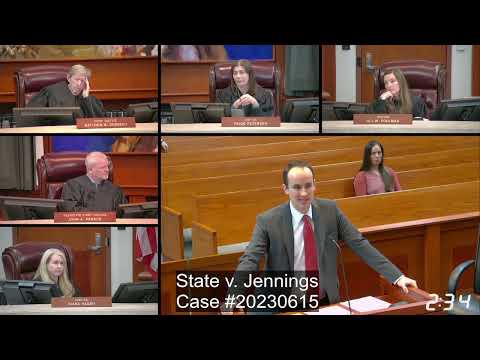
SALT LAKE CITY — During oral argument, the Utah Supreme Court weighed whether a defendant seeking a pretrial justification hearing must do more than allege self‑defense in a motion and proffer, or whether that proffer is treated as true for the prima facie stage and only later subject to the State’s clear‑and‑convincing rebuttal.
Eric Grange, counsel for the petitioner, told the justices that "a prima facie claim does not require a burden of proof and can be met by a proffer of facts" and pointed to record proffers and an Instagram message where the defendant said the other person "attacked him first." Grange argued the nonlethal or "regular force" subsection applies here because the defendant did not know he was using deadly force when he struck the other person.
The State's attorney disputed that the proffer alone should carry a defendant past the prima facie threshold without some indicia of the defendant's subjective belief. The State urged the court to view the incident through a matrix of intent and result, saying that when death results the facts often are the strongest evidence of intent or likelihood that the defendant used force intended or likely to cause death. "In some situations," the State said, "you can have an eggshell‑victim or an accident with extra steps, but here we have three‑ and five‑inch stab wounds," which the State argued weigh against treating the dispute as a simple proffer.
Justices repeatedly questioned how the statutory language should be read. Several asked whether the statute's use of the word "claim" indicates that a defendant's written allegations suffice to trigger the hearing, or whether the court must demand more of the defendant to give the State fair notice of what it must rebut. The State emphasized the importance of notice: "what are we trying to disprove here?" its counsel asked, arguing the defendant is uniquely situated to state what he believed and therefore must supply enough to allow the State to meet its burden.
Defense counsel acknowledged the tension in the statute but urged the court to protect the constitutional right to self‑defense, arguing that the legislature used "claim" intentionally and that the court can and should accept a plausible proffer at the prima facie stage and then weigh evidence at the clear‑and‑convincing stage. "You can just say... this is my story, and this is what I was thinking," the State summarized of the proffer mechanism while explaining why the State views the statute as imposing an evidentiary burden once the hearing proceeds.
The justices also probed whether the nonlethal versus lethal justification subsection should turn on the defendant's subjective intent or on an objective view of the force used. Counsel disagreed about whether a fatal result should automatically route the case into the lethal subsection or whether nonlethal justification can "take you all the way" in some circumstances (for example, an accidental death arising from an otherwise nonlethal defensive act).
The court asked whether additional guidance to district courts is necessary given the tension between provisions that speak of taking evidence at the hearing and the statutory language describing a claim. Several justices noted Clara and other precedent but sought clearer direction on when a proffer is sufficient to require the State to prove by clear and convincing evidence that the defendant was not justified.
In closing, Grange urged reversal for further proceedings, reiterating that the proffer and the record support a prima facie claim. The State reiterated that the facts and applicable precedent permit the district court to require more than bare allegations in some cases. The Utah Supreme Court took the matter under advisement.