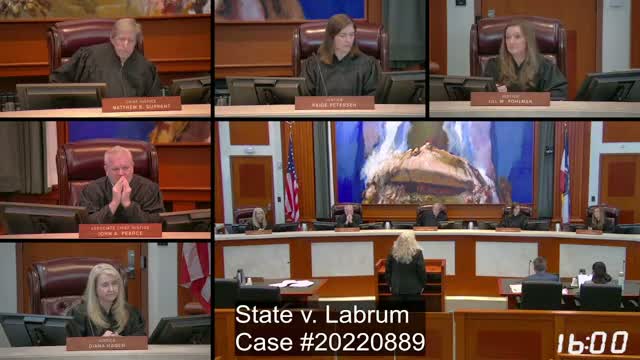
Utah Supreme Court hears argument in State v. Labrum over limits on refiling criminal charges
Summary
At oral argument in State v. Labrum, the state urged the Utah Supreme Court to relax a longstanding rule that can bar prosecutors from refiling charges after a magistrate declines to bind over, proposing a single, corrective refiling as-of-right; defense counsel warned that loosening the rule risks judge-shopping and harassment of defendants.
The Utah Supreme Court heard argument in State v. Labrum on whether the court should modify its prior rule limiting prosecutors’ ability to refile charges after a magistrate finds no probable cause. State attorney Karen Klusnick told the justices the court should reconsider that rule because later decisions and the Victims’ Rights Amendment changed the legal landscape and because the prior opinion ‘‘was short on analysis’’ and ‘‘largely reactive’’ to the facts of the original case.
Klusnick urged the court to adopt a rule that would permit at least one corrective refiling as a matter of right, saying that approach would ‘‘cover innocent mistakes’’ and avoid unduly hamstringing prosecutors while remaining subject to limitations for demonstrated bad faith. ‘‘Fundamental fairness does not require a hard and fast rule, basically, of no refiling,’’ she argued, adding that egregious prosecutorial conduct should still preclude refiling.
Defense counsel responded that the prior decision provides indispensable guardrails against prosecutorial harassment and judge-shopping. Appellee counsel said the facts here—where a magistrate declined to bind over a theory of the case and the prosecution later dismissed and refiled charges before a different judge—show the risk the court previously sought to prevent. ‘‘We’re talking about harassment,’’ counsel said, arguing that the office’s post-hearing conduct and delay demonstrated bad faith and that existing precedent and procedural remedies (appeal, motion to reconsider, reopening the hearing) should have been pursued.
Justices pressed both sides on where a constitutional limit should be drawn: is a single second magistrate review categorically different from multiple attempts that begin to look like harassment? Several justices asked whether the state’s proposed rule would be rooted in constitutional principle or would be better handled as court rulemaking. Counsel for the state cited comparative practice in other jurisdictions—California and New Jersey were discussed—as models that permit limited refilings while reserving scrutiny for repeat attempts.
The argument also explored practical issues raised by modern preliminary hearings in Utah, including Rule 7B of the Utah Rules of Criminal Procedure and the expanded use of sworn hearsay statements at preliminary stages, which defense counsel said has reduced the preliminary hearing to a ‘‘shell’’ in some cases and heightens the need for protective limits on refiling.
The court did not announce a ruling from the bench. After hearing rebuttal and extended questioning, the justices took the matter under advisement and adjourned the argument.
The next step is the court’s internal deliberation on whether to modify, clarify, or reaffirm its prior decision about refiling limits; the justices did not set a public timetable for a written decision.