Get Full Government Meeting Transcripts, Videos, & Alerts Forever!
Get email alerts on the Healthcare Regulation topic
No spam. Unsubscribe anytime.
Utah Supreme Court wrestles with whether nurse practitioners may perform certain ablative cosmetic procedures
Summary
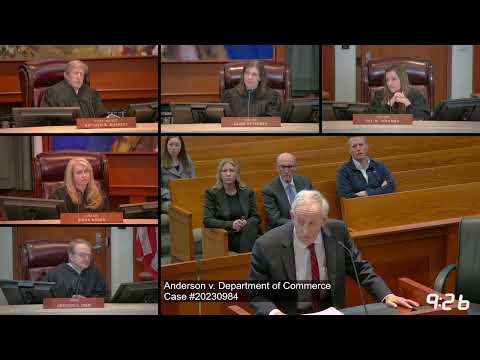
In Anderson v. Department of Commerce the Utah Supreme Court heard competing views over whether the Nurse Practice Act—s scope-of-practice term "correction" permits advanced practice registered nurses to perform some surgical procedures, and whether that interpretation conflicts with other licensing provisions and SB 40 (2012).
The Utah Supreme Court heard oral argument in Anderson v. Department of Commerce over whether the Nurse Practice Act—s scope-of-practice language allows advanced practice registered nurses (APRNs) to perform some surgical procedures, including the ablative body contouring at issue in this case.
Petitioner James Jardine told the court the central question is statutory: does the Nurse Practice Act—s authorization to "diagnose, treat and correct" include surgical procedures? "If the answer to that question is yes," Jardine said, "then . . . Ms. Anderson was authorized to perform the body contouring which was challenged." He urged a plain-language reading of "correction" that would include procedures such as wart and mole removal, circumcision and other interventions the Utah Board of Nursing panel found to be within APRN practice.
Sarah Goldberg, arguing for the Department of Commerce, countered that the licensing statutes read together demonstrate the legislature did not intend APRNs to perform ablative cosmetic medical procedures. Goldberg noted SB 40 (2012) and related licensing rules, argued the statute—s exception requiring the authority "to operate or perform a surgical procedure" is narrower than the general scope-of-practice exemption, and pointed to a nondelegation provision that limits physician delegations of certain ablative procedures to nonphysicians except in enumerated circumstances.
Justices pressed both sides on definitions and limits. Several asked whether "surgery" must mean cutting open the body or whether common skin procedures fit the term; whether the statutory phrase "as defined by rule" implies a role for agency rulemaking; and whether the limitation that APRNs may administer only local anesthesia is a meaningful constraint. Jardine emphasized the absence of rulemaking and evidence in the record that the contested procedure is performed widely in other states, and noted the record includes that the device used (identified in the record as the "VibroSat power machine") is FDA-cleared and that practitioners at the clinic carried malpractice insurance. Goldberg stressed legislative history and statutory structure, saying the bill sponsor—s statements and the differential treatment of dentists and podiatrists support a narrower reading.
The court also discussed remedies and remand. Counsel for the petitioner argued the Utah Board of Nursing panel—s findings that the contested procedure falls within APRN scope are in the record and that further proceedings would prolong hardship for Ms. Anderson; the Department—s counsel said the panel—s recommended order was not adopted and that the commission reached a different legal conclusion.
After extended questioning the justices took the case under advisement and recessed briefly to reconstitute the court. The court did not announce a decision at the hearing.
The central legal dispute for the court is whether the ordinary meaning of "correction" in the Nurse Practice Act can encompass surgical procedures without creating a conflict with other licensing statutes and specific exemptions for ablative cosmetic procedures. The court indicated it will weigh plain-language arguments, statutory harmonization rules, and the record evidence (including the nursing panel—s findings and the FDA clearance noted in the record) in reaching a disposition.