Get Full Government Meeting Transcripts, Videos, & Alerts Forever!
Get email alerts on the Defamation topic
No spam. Unsubscribe anytime.
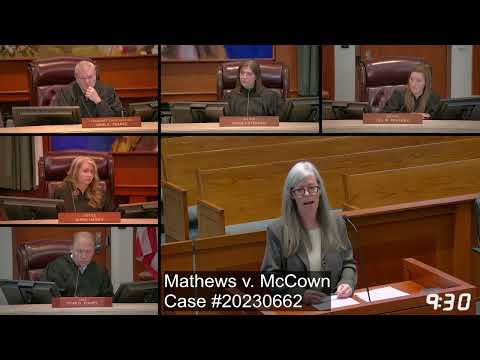
Utah Supreme Court Hears Defamation Appeal Over Online Posts; Justices Question Scope of Anti‑SLAPP Protection
Summary
The Utah Supreme Court heard arguments in Matthews v. McCown, an appeal alleging a years‑long defamatory online campaign tied to a local incorporation fight and raising whether anti‑SLAPP protections and pleading standards bar the suit. The court took the case under advisement.
The Utah Supreme Court heard oral argument in Matthews v. McCown on claims that community members ran a coordinated defamatory messaging campaign after a local incorporation dispute, with counsel and several justices debating whether the statements were factual, opinion, or protected participation under Utah's anti‑SLAPP statute.
Appellants' counsel Janet Conley told the court that Kyle Matthews and Ryan Sorensen "have been harmed and they're trying to protect themselves from continued harm, from the defamatory messaging campaign spearheaded by Higgins, Nielsen, and McCown." She traced the history to a feasibility petition and a December 2020 lawsuit that was dismissed, then said defendants circulated that dismissed complaint in December 2021 and continued online postings that injured her clients' reputations.
Defense counsel disputed the complaint's legal sufficiency and, for some defendants, invoked the anti‑SLAPP statute. Stephen Bergman, arguing for Charles McCown, said McCown's involvement was "purely, because of his concern for the community" and urged that his activities be treated as protected participation in the initiative process. Robert Mansfield, for Camille Higgins, argued the complaint relies on conclusory assertions lacking the factual detail required to show actual malice or absence of privilege.
Justices repeatedly probed two central issues: (1) whether statements such as that a document was "doctored" are statements of fact susceptible to verification or protected opinion, and (2) whether privilege and anti‑SLAPP protections are properly resolved on the pleadings or require factual development. One justice framed the pleading question this way: is privilege an element plaintiffs must plead or an affirmative defense a defendant must prove? Counsel offered competing readings of Utah precedent; appellants cited Graves v. Utah County and urged the court to permit at least one statement to proceed to discovery, while defense counsel pointed to cases that treat context, platform, and vagueness as insulating.
Bench questioning also focused on whether plaintiffs adequately alleged that defendants knew statements were false (the knowledge component of actual malice). Appellants pointed to filings from the earlier litigation, affidavits, and a GRAMA request as evidence they would develop in discovery; the bench repeatedly noted the current posture is a motion‑to‑dismiss or motion for judgment on the pleadings, which constrains how much the court can rely on extrinsic materials.
Counsel debated the anti‑SLAPP standard and the statutory requirement that the movant show by clear and convincing evidence that the plaintiff's primary purpose was to chill participation in government. Defense counsel argued that plaintiffs' own filings and the defendant McCown's affidavit supported the district court's finding that the motion met that standard; appellants disputed that characterization and emphasized that the district court's order contained few factual findings.
Several justices observed that some alleged statements are unquestionably puffery or opinion while others — such as assertions that signatures were forged or documents "doctored" — sound factual and could be capable of defamatory meaning depending on context and the evidence. Counsel for the defense stressed the informal online settings (social media, community forums) and the lack of specificity identifying a single plaintiff in some posts as reasons to treat the remarks as nonactionable opinion.
The court did not issue a decision at argument. At the close of oral argument the bench announced it would "take the matter under advisement" and temporarily recessed to reconstitute the panel.