Get Full Government Meeting Transcripts, Videos, & Alerts Forever!
Get email alerts on the Tax Domicile Utah Code 59 10 136 topic
No spam. Unsubscribe anytime.
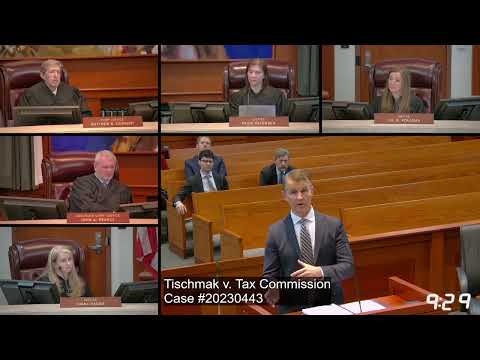
Utah Supreme Court weighs challenge to spouse-based domicile rule in tax statute
Summary
In oral argument, attorneys debated whether Utah Code 59-10-136 unconstitutionally treats a nonresident as domiciled in Utah solely because their spouse has Utah ties; appellant—s counsel said the irrebuttable presumption ignores the taxpayer—s own contacts, while the Tax Commission urged consideration of joint filing and other contacts and said the statute is constitutional.
SALT LAKE CITY — The Utah Supreme Court heard arguments challenging a provision of the state—s domicile statute that, the petitioner says, automatically deems a nonresident to be domiciled in Utah if their spouse has established ties to the state.
"The statute that we are here reviewing, which is Utah code 59, 10, 136, is very straightforward in its effect and its impact," said Mike Black, attorney for appellant Terry Tishmack. He told the court the provision creates an "immediately and irrebuttably presumed" domicile for a nonresident whose spouse attends school in Utah, has a permanent home, or otherwise established domicile in the state.
Black argued that the presumption removes the individualized inquiry courts normally use to determine domicile and therefore "ignores your choice" to live in another state. He told the justices the law asks only whether a spouse meets those conditions and then treats the taxpayer as a Utah resident regardless of the taxpayer—s own contacts. "It immediately takes away from them all of their right to choose where they reside," Black said.
Counsel and the justices spent substantial time on how the statute interacts with federal filing choices. A justice asked whether filing "married filing separately" would avoid the effect; Black acknowledged subsection 5 provides an exception if the taxpayer filed separately but said that does not cure the statute—s facial constitutional problem. He said federal joint filing is not a waiver of constitutional rights and does not, by itself, mean a person has accepted Utah residence.
"There's nothing about the federal filing that would indicate that that's going to happen," Black said, arguing that the state cannot condition a person's right to choose residence on a federal filing decision.
Black also framed the argument in federal constitutional terms, arguing due process and dormant Commerce Clause concerns. He warned the statute could produce "dual primary domiciles," so that Utah and another state could both claim the same person as primarily domiciled, with each taxing worldwide income in theory, because Utah—s credit statute (Section 59-10-1003) credits only income "derived from sources within that other state," counsel said.
Sarah Goldberg, representing the Utah State Tax Commission, told the court the petitioner had not met the burden to show the statute is unconstitutional. "Mr. Tishmack cannot satisfy his burden to demonstrate that the domicile statute is unconstitutional," she said, adding she believed the bench might be looking at a different, more recent version of the statute and clarifying that the version before the court includes the married-filing-separately exception the justices discussed.
Goldberg said joint federal filing is a mutual decision that reflects combined finances and legal liability for tax purposes and that the due process minimum-contacts inquiry requires considering the full set of circumstances. "When you file your federal tax returns jointly, you're saying our finances are combined," Goldberg said. She also noted that, in this case, the commission identified additional Utah contacts the taxpayer had, including joint property ownership, vehicle registration and receipt of a residential property tax exemption.
On the dormant Commerce Clause and the potential for double taxation of intangible or foreign-source income, Goldberg cited precedent and argued that the domicile statute itself does not discriminate against interstate commerce and that double-taxation alone does not automatically translate into a Commerce Clause violation.
Several justices questioned both sides about how the statutory presumptions operate as a "waterfall" (subsection 1 presumptions first; later subsections only apply if the presumptions fail), and whether the statute—s mechanics properly allow for an individualized inquiry into the taxpayer—s ties to another state. Counsel debated whether the statute impermissibly looks only to a third party—s (the spouse—s) actions instead of the taxpayer—s own contacts.
The court thanked counsel and took the matter under advisement. Chief Justice Durant announced a brief recess and said the court would next hear State v. Barani when it returns.
The court did not issue a ruling from the bench at the close of argument.