Get Full Government Meeting Transcripts, Videos, & Alerts Forever!
Utah Supreme Court hears arguments on allocution: must prejudice be shown on appeal?
Summary
In State v. James the Utah Supreme Court heard competing arguments over whether a district court's failure to invite a defendant to allocute requires the defendant to prove prejudice on plain-error review or whether prejudice should be presumed; the court took the case under advisement after extended questioning. Counsel for the State urged the Court to require proof of a reasonable likelihood of a different outcome; counsel for the respondent urged reversal and remand for resentencing.
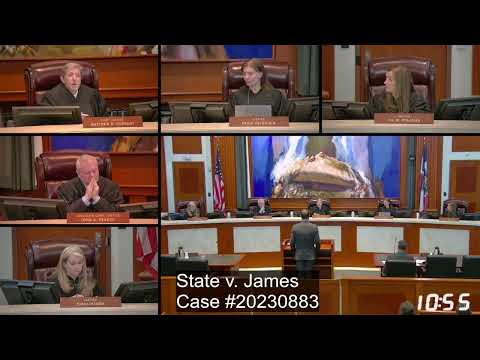
The Utah Supreme Court on Monday heard oral argument in State v. James over whether a district court's failure to invite a defendant to allocute at sentencing requires a showing of prejudice on plain-error review or whether prejudice is presumed.
Daniel Boyer, arguing for the State, told the justices that under Utah precedent a defendant raising an unpreserved constitutional claim must prove prejudice as the third element of the plain-error test. "Plain error requires the defendant appellant to prove prejudice as its third element, a reasonable likelihood of a more favorable result absent the error," Boyer said, urging the court to follow Bond and similar cases that apply the prejudice requirement.
Eric Grange, representing Franklin James, countered that a denial of the right to allocute is the type of error that undermines the sentencing process and that a defendant who shows he was denied allocution has carried his…
Already have an account? Log in
Subscribe to keep reading
Unlock the rest of this article — and every article on Citizen Portal.
- Unlimited articles
- AI-powered breakdowns of topics, speakers, decisions, and budgets
- Instant alerts when your location has a new meeting
- Follow topics and more locations
- 1,000 AI Insights / month, plus AI Chat