Get Full Government Meeting Transcripts, Videos, & Alerts Forever!
Get email alerts on the Allocution Plain Error topic
No spam. Unsubscribe anytime.
Utah Supreme Court hears arguments on allocution: must prejudice be shown on appeal?
Summary
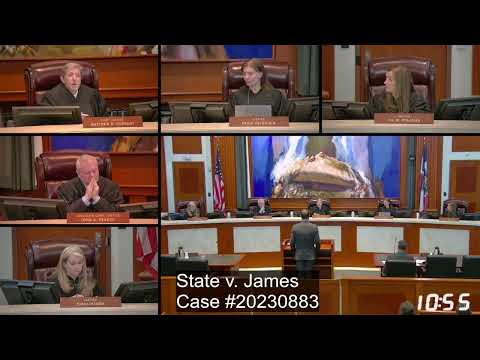
In State v. James the Utah Supreme Court heard competing arguments over whether a district court's failure to invite a defendant to allocute requires the defendant to prove prejudice on plain-error review or whether prejudice should be presumed; the court took the case under advisement after extended questioning. Counsel for the State urged the Court to require proof of a reasonable likelihood of a different outcome; counsel for the respondent urged reversal and remand for resentencing.
The Utah Supreme Court on Monday heard oral argument in State v. James over whether a district court's failure to invite a defendant to allocute at sentencing requires a showing of prejudice on plain-error review or whether prejudice is presumed.
Daniel Boyer, arguing for the State, told the justices that under Utah precedent a defendant raising an unpreserved constitutional claim must prove prejudice as the third element of the plain-error test. "Plain error requires the defendant appellant to prove prejudice as its third element, a reasonable likelihood of a more favorable result absent the error," Boyer said, urging the court to follow Bond and similar cases that apply the prejudice requirement.
Eric Grange, representing Franklin James, countered that a denial of the right to allocute is the type of error that undermines the sentencing process and that a defendant who shows he was denied allocution has carried his burden of demonstrating prejudice absent extraordinary circumstances. "Denying a person his right to allocution is tantamount to denying him his most persuasive and eloquent advocate at sentencing," Grange said, asking the court to affirm the Court of Appeals and remand for a new sentencing hearing where Mr. James could speak.
The central dispute before the justices was whether allocution is functionally unique enough to make the ordinary plain-error prejudice inquiry inappropriate. Several justices pressed both sides on the point: some questioned whether allocution serves broader rehabilitative and dignity-related purposes — for example, enabling a defendant to humanize himself or apologize — that are not captured by an outcome-focused prejudice test; others focused on legal consistency and asked whether adopting a presumption of prejudice would effectively convert the error into a structural rule.
Boyer urged the court to adhere to an objective, record-based inquiry, saying defendants could develop a Rule 23 remand or an ineffective-assistance-of-counsel claim to supply the concrete facts necessary to show a reasonable likelihood of a different sentence. He cautioned that treating allocution denials as presumptively prejudicial would invite sandbagging and place significant burdens on the courts.
Grange replied that federal circuit authority, historical common-law practice, and surveys of federal judges show allocution frequently influences sentencing decisions and that the practical remedy is a resentencing or a simple opportunity for the defendant to make a personal statement rather than a speculative paper record. He said the Court of Appeals limited its ruling to ordinary sentencing cases and did not suggest it would reach distinct capital procedures.
The justices also debated remedial mechanics: whether a Court of Appeals remand should produce a full new sentencing hearing where the defendant appears in person or whether a narrower procedure would suffice. Questions about the impact on victims and the criminal-justice system if resentencings became routine were also raised.
After extended questioning of both advocates on statutory and federal precedent, the justices thanked counsel and took the matter under advisement. The Court did not announce a decision at the argument's end.
What happens next: the Utah Supreme Court will issue an opinion that resolves whether, for unpreserved allocution claims, the third prong of the plain-error test requires a showing of a reasonable likelihood of a different result or whether prejudice is presumed in the ordinary case; the court's ruling will determine whether Mr. James must be given a new sentencing hearing or whether the appellate record must demonstrate that allocution would likely have changed the sentence.