Get Full Government Meeting Transcripts, Videos, & Alerts Forever!
Get email alerts on the Public Duty Doctrine topic
No spam. Unsubscribe anytime.
Utah Supreme Court hears challenge over whether public duty doctrine shields Salt Lake City from nuisance suits over encampments
Summary
In Berani v. Salt Lake City, plaintiffs told the Utah Supreme Court that nuisance conditions — tents, obstruction of rights-of-way and public sanitation problems — originate on city land and that municipal liability should mirror private landowner liability; Salt Lake City urged the court to uphold the public duty doctrine and the 2014 statutory codification shielding governments from third-party conduct claims.
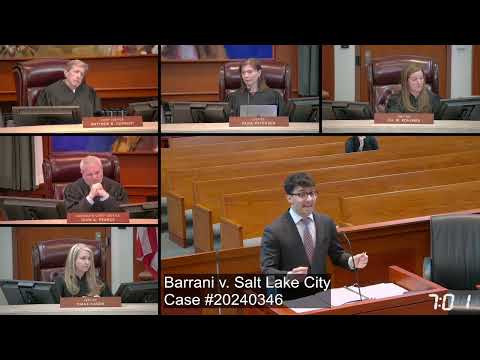
The Utah Supreme Court heard argument in Berani v. Salt Lake City over whether the public duty doctrine bars private nuisance claims against a municipality for encampments and related conditions that occur on city-owned land. Plaintiffs’ counsel argued the city should be treated "the exact same way" a private landowner would be treated when third parties create nuisances on its property, while Salt Lake City’s counsel warned that allowing such suits would expose governments to unmanageable litigation.
Plaintiffs’ lawyer Ilan Wurman told the court the case centers on a simple factual claim: "the nuisance here emanates from, originates, and exists on city land," and the conditions — tents that obstruct rights-of-way and public urination and defecation — qualify as public nuisances that spill over to adjoining properties and businesses. He relied on private‑landowner nuisance principles in the Restatement and cases such as Wade v. Fuller and Utah decisions the briefs cite, and argued that longstanding doctrine and other jurisdictions show municipalities can be liable where third parties create nuisances on their land.
Wurman asked the court to reject a municipal "carve‑out" from nuisance liability based on the public duty doctrine, offering two limiting points he said defeat the doctrine here: the duty to keep rights‑of‑way free from obstructions is not uniquely governmental and removal of street obstructions is a nondiscretionary duty enforceable by mandamus. He also told the justices that remedial responses need not rely on arrests: in a cited Phoenix case, an encampment of about "800 to a thousand" people produced one arrest, and after the city signaled it would no longer tolerate certain encampments and offered shelter, "the vast majority of them accepted shelter." He said plaintiffs plan to show at trial either that the city consented to camping through knowledge and acquiescence or that it failed to take reasonable steps to abate the nuisance.
Salt Lake City counsel Catherine Nichols responded that the public duty doctrine, as the court has recognized and as the Utah Legislature codified in 2014, bars the type of claim the plaintiffs advance. Nichols characterized the duty at issue as "the duty to prevent crime and illegal behavior," which she called a quintessential public duty, and argued that permitting broad failure‑to‑prevent suits would overwhelm municipalities and force courts to micromanage wide policy and resource decisions. She urged the court to preserve the doctrine’s role in channeling complaints through the political and administrative process rather than through litigation.
Justices pressed both sides on several recurring fault lines: whether plaintiffs seek relief limited to property adjoining the encampments or a citywide injunction; whether the 2014 statutory amendment displaced or codified the common‑law public duty doctrine; whether removal of obstructions and abatement of certain nuisances are truly nondiscretionary; and whether narrow, tailored injunctions could be crafted and enforced without creating unworkable judicial commands or disproportionate shifts in municipal priorities. Plaintiffs repeatedly emphasized localized relief (they identified Pioneer Park and specific downtown corridors) and disputed that the public duty doctrine should apply where a private‑landowner parallel exists.
No decision was announced. The court took the matter under advisement after brief rebuttal argument, and the justices adjourned.
What’s next: The Supreme Court’s ruling could clarify the interplay between nuisance law and Utah’s public duty doctrine — including how the 2014 statutory language should be read — and whether municipal ownership of land changes the liability analysis when third parties create conditions the adjacent landowners say constitute public nuisances. If the court remands, plaintiffs said they would seek to prove at trial either city consent or unreasonable failure to abate.