Get Full Government Meeting Transcripts, Videos, & Alerts Forever!
Get email alerts on the Evidence Rule 412 topic
No spam. Unsubscribe anytime.
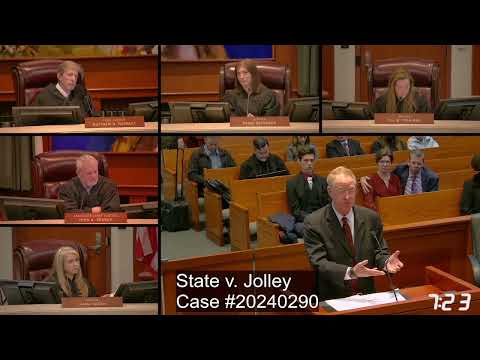
Utah Supreme Court Hears Argument Over Whether Victim May Be Subpoenaed for Rule 4.12 Hearing in State v. Jollin
Summary
At oral argument in State v. Jollin, advocates and defense counsel disputed whether a trial judge may subpoena a victim to testify at a Rule 4.12 hearing; the petitioners urged reversal for procedural and state‑constitutional reasons, while defense counsel argued an evidentiary hearing was necessary and proffers are insufficient.
SALT LAKE CITY — The Utah Supreme Court heard oral argument over whether a trial judge may allow a defense subpoena to require a victim to appear at a Rule 4.12 hearing, the state’s rape‑shield procedure, in State v. Jollin.
Paul Cassell, counsel for the victim identified in the record as TT, told the court the district court erred by permitting the defense to subpoena the victim to be examined at a Rule 4.12 hearing. "The District Court erred in allowing the defense to subpoena T," he said, framing the case as a narrow procedural question about what procedures a district court must use when deciding whether prior sexual‑history evidence is admissible.
Why it matters: The court’s resolution could affect how trial judges handle motions to introduce prior sexual‑history evidence, and — according to advocates — could shape protections for victims across numerous prosecutions. Cassell argued the district court both misread the Rule 4.12 procedure and failed to address state constitutional victims’ rights that were raised below.
What the petitioners argued: Cassell told the justices that Rule 4.12(c) requires the defendant to file a motion that specifically describes the prior history evidence sought and the purpose for which it will be offered, and that judges typically decide admissibility from that proffer rather than by taking live testimony in a discovery‑style examination. He cited State v. Blake and the federal rule history, noting that the Federal Rules of Evidence were revised in the 1990s to remove language that had allowed district courts to take testimony for these preliminary determinations. He also urged the court to resolve state‑constitutional claims because the district court's order did not address them.
What the State told the court: State counsel argued the district court should have quashed the subpoena. The State summarized four reasons, including that a Rule 4.12 hearing is not a discovery tool, that compelling the victim to testify may be unreasonable given the hearing’s limited purpose, that the defendant could have identified the evidence without the victim’s testimony, and that the district court failed to protect TT’s constitutional claims.
Defense position: Scott Wake, counsel for defendant Seth Jolley, countered that Rule 4.12(c) does not prohibit an evidentiary hearing and that, in some circumstances, the court needs live testimony to make the factual findings required for admissibility. Wake argued his client has a right to remain silent, which complicates the defense’s ability to present a full picture without calling the victim, and said attorney proffers about what a witness will say are often unreliable. "I don't think I should proffer the victim's testimony. I don't think that's my place," Wake told the court, arguing that an in‑camera evidentiary hearing — with protections such as a closed proceeding and limited attendance — would allow the judge to make necessary findings while limiting public exposure.
Justices’ focus: Several justices pressed both sides on whether a sufficiently detailed motion or proffer could allow the court to rule on admissibility without compelling live testimony, and whether victims may nevertheless choose to be heard at the hearing. At one point a justice asked whether a court could make a preliminary admissibility ruling based on a defendant’s motion and then give the victim an opportunity to contest the scope; petitioners and the State said that approach might avoid unnecessary intrusion while preserving victims’ rights in appropriate cases.
Evidence and case law cited: Counsel discussed State v. Blake, State v. Lopez, State v. DeJesus, and appellate decisions they said speak to whether proffers suffice or whether an evidentiary hearing is appropriate when the truthfulness or scope of prior allegations is contested. Counsel also referenced the federal rules' 1993–1994 revisions and argued about the historical intent behind the procedural text of Rule 4.12.
Outcome and next steps: The court took the case under advisement and recessed. No opinion was issued from the bench. The court did not announce a timetable for its decision at the hearing.
Notes on attribution: Quotes and attributions are taken from counsel and the State’s statements in the oral argument transcript; the State’s advocate is not named in the record of this argument. The victim is identified in the record as "TT."