
DNR and State Forest Service back improvements to Xcel's wildfire plan, urge state-specific data and an advisory group
Get AI-powered insights, summaries, and transcripts
Subscribe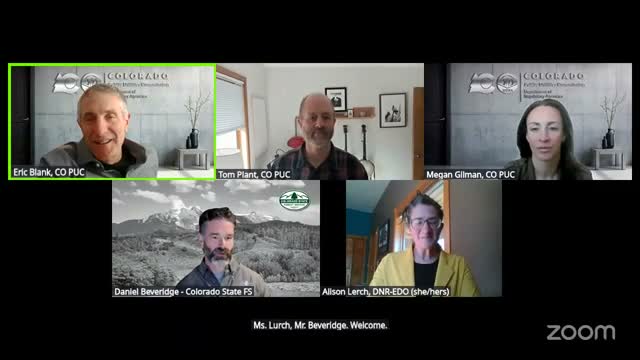
Summary
Colorado Department of Natural Resources and the Colorado State Forest Service told the Public Utilities Commission that while Xcel Energy's mitigation plan is a strong start, the company should use state-specific higher-resolution data, expand ecological risk metrics and work with a multi-agency advisory group and local partners to align investments and PSPS criteria.
Allison (introduced on the record as "Lisonbee") Lerch, policy advisor for forestry and wildfire mitigation at Colorado's Department of Natural Resources, and Daniel Beveridge, fire fuels and watershed manager at the Colorado State Forest Service, presented a joint review of Xcel Energy's 2025-2027 wildfire mitigation and public safety power shutoff plan.
They praised the scale of Xcel's proposed investments while urging refinements. Beveridge noted the plan currently uses a national 30-meter baseline and said the state's wildfire risk assessment uses higher-resolution, state-specific 20-meter data. "We are interested in why Xcel Energy is not using data refined specifically for the state of Colorado," Beveridge said, recommending future risk assessments incorporate more nuanced impacts such as effects on water resources, carbon storage, air quality and soils.
The agencies encouraged Xcel to broaden academic and federal lab partnerships (for example, Colorado State University, the National Center for Atmospheric Research and Los Alamos) and to consider forming an advisory group to ensure utility investments are coordinated with other state mitigation efforts, including the Colorado Strategic Wildfire Action Program (CoSWAP) and the Colorado Forest Health Council.
On PSPS mechanics, CSFS asked for clarifications about the technical criteria for a shutoff trigger, specifically how "low fuel moisture" is defined, whether thresholds vary by fuel type or elevation, and whether moisture data will be modeled or measured on site. Commissioners requested written follow-up addressing data resolution, the quantitative risk framework, fuel-moisture definitions, and advisory-group options.
DNR emphasized shared stewardship of forests, watersheds and communities and warned Colorado remains at risk: "Colorado is 1 lightning strike, 1 unattended fire, and 1 drought season away from our next megafire," the presenters said, urging adaptive planning and sustained cross-agency coordination. The presenters offered to file supplemental academic and technical materials into the record.