Get Full Government Meeting Transcripts, Videos, & Alerts Forever!
Get email alerts on the Emergency Sheltering topic
No spam. Unsubscribe anytime.
Residents and officials press Haywood County for faster temporary housing after Helene; commissioners push back on viral claims
Summary
Residents, volunteers and the sheriff traded conflicting accounts at the Dec. 2 Haywood County commissioners meeting over how many storm-displaced people remain unsheltered. Speakers pressed the board for short-term fixes—tiny homes, campers and pallet shelters—while officials said churches, FEMA and county staff have been working to house survivors and warned against misinformation.
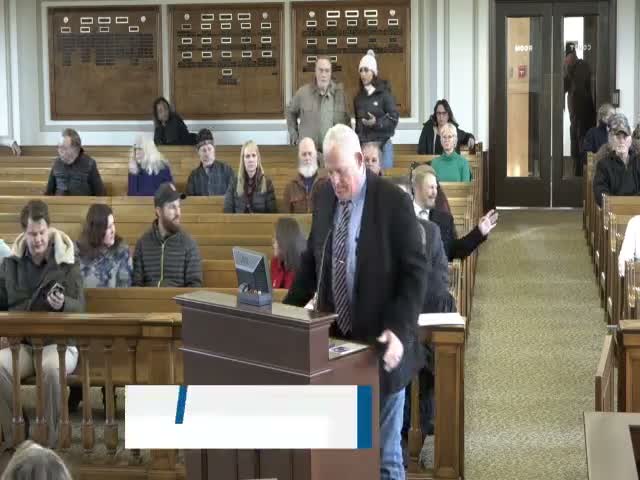
Haywood County residents and volunteers urged county commissioners on Dec. 2 to cut red tape and speed temporary housing for families left homeless by Tropical Storm Helene, while county leaders and the sheriff defended the local response and warned that social-media videos have circulated misleading claims.
The meeting’s public-comment period ran more than an hour and included multiple appeals for immediate shelter. ‘‘If we’ve got one person in this county that’s homeless because of Helene, we need to cut through the red tape, get them warm, keep them fed,’’ said Barry Peppers, a resident who suggested renting VRBOs, campers or tiny homes as stopgap measures. Several speakers described seeing people in tents and asked the county to relax zoning or permitting rules so donated campers and small, temporary structures could be used.
Eustace Conway, who identified himself as the founder of the Turtle Island Preserve and said he drafted a state law addressing ‘‘primitive camp’’ structures, urged commissioners to use that statutory alternative for temporary shelters. ‘‘House Bill 774 . . . says any structure primarily used or associated with outdoor camping activities . . . can be used for temporary housing,’’ Conway told the board, urging officials to consider nonpermanent camping structures as a humane short-term option.
At the same time, Sheriff (identified at the meeting only by his office) told the commissioners he had investigated a widely circulated video and that deputies had spent hours searching for people in tents ‘‘and I’m pleased to report to you today, 0 people were found.’’ The sheriff credited local churches and volunteer groups with much of the on-the-ground relief and asked residents to be careful about unverified social-media posts. ‘‘There are social media antagonists who are saying things about our county that are not true,’’ he said.
The meeting recorded sharp exchanges over that contrast. Several commissioners and residents said they had seen people still living outside and pressed the county to accelerate temporary options, pointing to donated campers that are park-ready but blocked by municipal zoning or hookup requirements in some locations. Others, including commissioners, said the county and FEMA already had emergency measures and hotel-voucher programs in place and that volunteers had placed many families in temporary shelter.
John Ward, who said he made a video about local conditions, called on the county to open county property (the fairgrounds) to FEMA or to lease land to provide trailer pads. ‘‘If FEMA’s not gonna help, I was asking you all to help and give them a place to stay,’’ Ward said.
County officials reiterated legal limits. One commissioner reminded the public that the county does not have zoning authority inside municipalities and that some short-term options require municipal approvals. County staff and commissioners asked anyone who knew of specific families still in danger to provide names and addresses so staff and the sheriff’s office could follow up directly.
The meeting also turned personal at points: several commissioners described receiving threatening messages and profane emails after the viral videos circulated, and one commissioner read out abusive texts the board had received.
Looking ahead, officials said immediate help remains available through FEMA transitional sheltering and local volunteer networks, and they asked residents to report precise locations of people in need so staff can check whether those households are voluntarily living outside or require rescue and shelter placement.
The board did not adopt any new emergency ordinance at the meeting; commissioners said some structural changes will require state-level or municipal action, and they pledged continued coordination with FEMA and local churches while emphasizing due diligence to prevent fraud or inadvertent safety risks.