Get Full Government Meeting Transcripts, Videos, & Alerts Forever!
Get email alerts on the Public Safety topic
No spam. Unsubscribe anytime.
Commissioners consider updating fire service district resolutions to include EMS/rescue and explore single countywide district
Summary
Staff told the board older fire service‑district resolutions do not clearly authorize EMS and rescue uses of tax funds; commissioners asked staff to clean up language, explore whether to keep eight districts or move to a single countywide district, and return with maps, pros/cons and deadlines for required hearings.
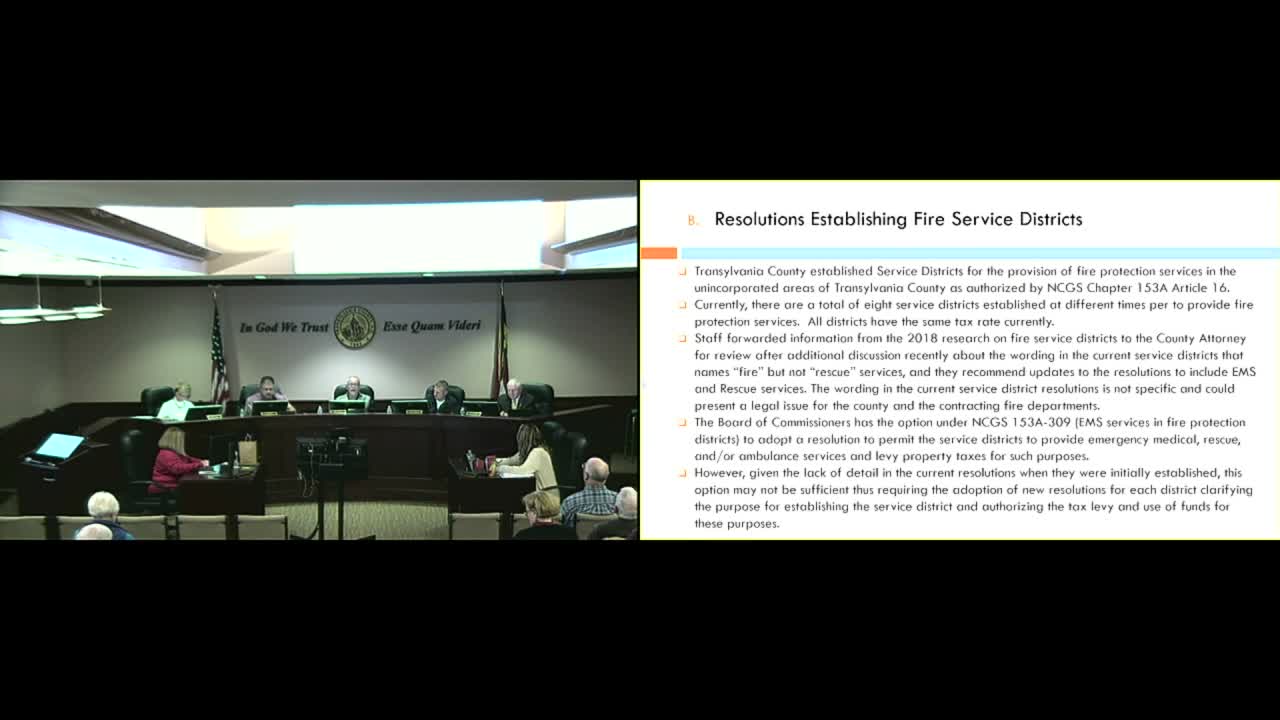
County staff told the Board of Commissioners that some longstanding fire service‑district resolutions do not explicitly authorize the use of tax funds for EMS and rescue services even though departments now commonly provide those functions, and they urged the board to update the language.
Assistant County Manager David McNeal summarized the statutory framework and said the county’s existing resolutions—many adopted decades ago—often reference only fire protection. McNeal explained that North Carolina statute provides options to adopt or modify service‑district resolutions to permit ambulance, EMS or rescue services and to levy property taxes for those purposes, but the older language may not be detailed enough to permit that use without new resolutions. "The county would need to work with our legal counsel to ensure that any changes follow the statutory guidelines for establishment of these service districts," McNeal said.
Staff presented three principal options for commissioner consideration: (1) update the eight existing service‑district resolutions to explicitly include EMS and rescue; (2) adopt eight new resolutions and set existing district rates to zero or go through a formal abolishment and re‑establishment process; or (3) create a single countywide service district that would simplify tax administration but raise questions about reserve funds, distribution, and local control.
Commissioners discussed finance and operational implications: tax‑administration staff currently makes manual splits for each bill because the county maintains multiple districts; a single district would streamline that work and could reduce administrative burden, but it would also require a public hearing and statutory notices and raise questions about preserving funds that individual departments hold in reserve. One commissioner said the current flat tax in practice is approximately 5.5 cents and that some departments would need a higher rate to fully cover budgets, while others are already supplemented by the general fund.
McNeal said any adopted changes would take effect July 1 of the fiscal year following adoption and noted mail notices and public hearings are required under statute. Staff recommended at minimum updating existing resolutions to include EMS and rescue language to remove ambiguity and reduce liability; commissioners asked staff to return after the first of the year with maps, a clear list of positives and negatives for each option, and a timeline that would show the deadlines for public notice and hearings if the board wants to pursue countywide restructuring.
No vote was taken; the board asked staff to compile additional detail and consult chiefs and affected stakeholders before making a decision.