Get Full Government Meeting Transcripts, Videos, & Alerts Forever!
Get email alerts on the Opioid Settlement topic
No spam. Unsubscribe anytime.
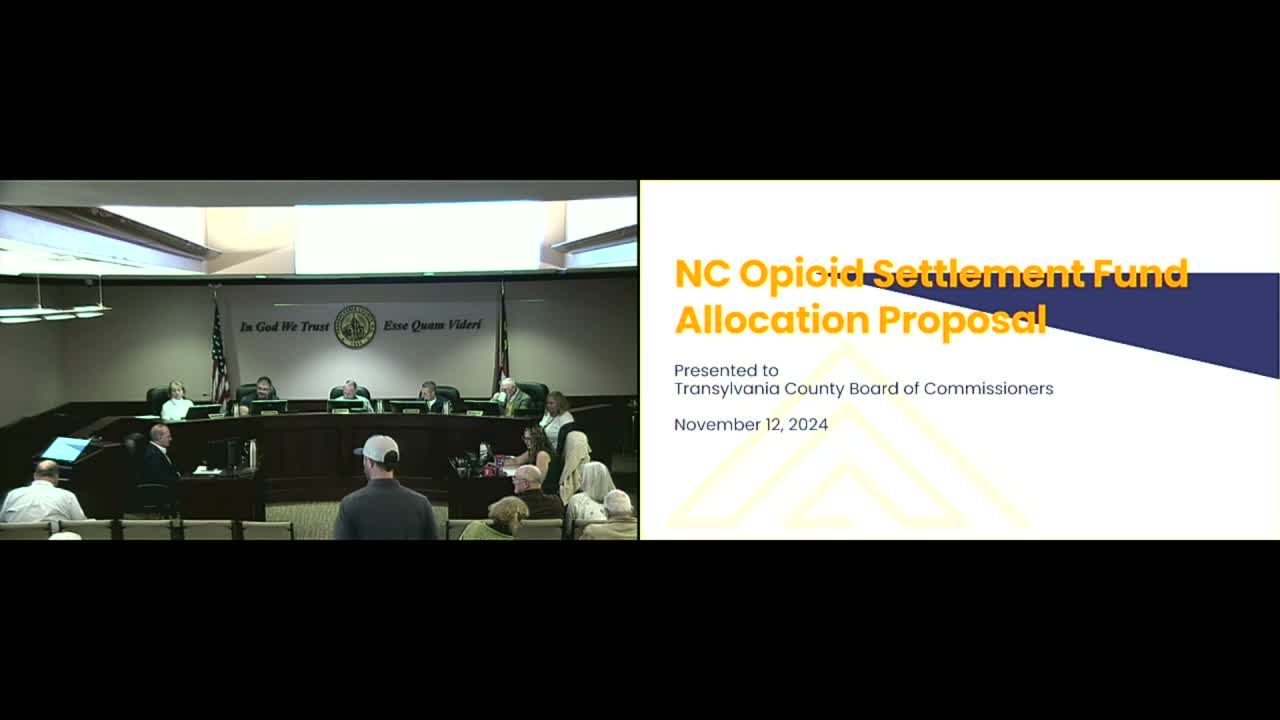
Commissioners approve $800,000 in opioid-settlement funds to sustain jail reentry and coordinator
Summary
The board unanimously authorized $800,000 from opioid-settlement funds through June 30, 2028 to sustain a half-time substance-use systems coordinator and the jail-based reentry/treatment program run with the Care Coalition and Sheriff’s Office; presenters said the investment supports grant-seeking and evidence-based services.
The Transylvania County Board of Commissioners voted to authorize $800,000 from the opioid-settlement special revenue fund to sustain the Care Coalition’s coordination work and a jail-based reentry and treatment program through June 30, 2028.
Health Director Elaine Russell introduced Kristen Gentry, the Care Coalition’s project director, and Sheriff Chuck Owenby, who detailed services provided through the jail-based reentry program. The presentation said the CARE coordinator role and the jail program are central to three near-term priorities: winning federal and foundation grants, expanding treatment and reentry services for justice-involved people, and delivering stigma-reduction education.
Kristen Gentry and staff asked the board to adopt a local spending-authorization resolution that would fund a half-time substance-use systems coordinator (estimated at about $59,000 per year including benefits) and sustain the jail-based reentry program (roughly $182,000 per year, covering two full-time staff, software and supplies). CARE said the proposed authorization "incurs no cost from the county" general fund because it draws from opioid-settlement proceeds.
Sheriff Owenby described program components — intake assessments, ongoing counseling and Narcan training, officer training and community partnerships including GED and job-skills work — and cited results: among participants incarcerated for more than a year who engaged with the program, the sheriff said there was a 47% decrease in arrests the following year and a 40% reduction in violent incidents.
Several commissioners expressed concern that the settlement money is personnel-heavy and asked how programming would be sustained after settlement dollars are spent. Presenters said CARE will continue pursuing federal grants and other philanthropic sources first and would use opioid-settlement funds as a backstop. The board was told additional settlement payments and monthly distributions are expected in coming years and that about $850,000 remains currently in the settlement fund in county custody, with further proceeds anticipated.
Following discussion, the board moved to adopt the spending-authorization resolution as read; commissioners voted aye and the motion passed.
Next steps: staff will implement the allocation, continue active grant pursuits, and return to the board if external funding replaces settlement dollars so the allocation can be reassigned to other strategies.