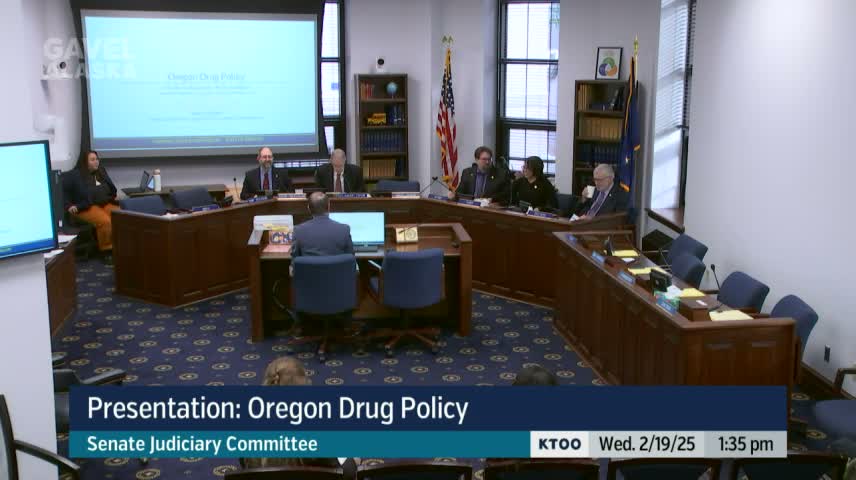
Alaska Judiciary Committee hears Oregon’s drug‑policy shift; presenter cites low treatment engagement and uneven enforcement
Loading...
Summary
Ken Sanchikran of the Oregon Criminal Justice Commission briefed Alaska’s Judiciary Committee on Oregon’s policy path from 2017 defelonization to Measure 110 (2020) decriminalization and 2024’s HB 4002 recriminalization, highlighting implementation delays, low assessment engagement (7%), and wide local variation in enforcement.
Ken Sanchikran, executive director of the Oregon Criminal Justice Commission, told a joint session of Alaska’s Senate and House Judiciary Committees on Feb. 19 that Oregon’s recent cycle of de‑felonization, voter‑led decriminalization and legislative recriminalization produced sharp drops in possession arrests but persistent challenges connecting people to treatment.
Sanchikran traced the state’s policy changes beginning with House Bill 2355 (2017), which created a new “user quantity” misdemeanor for possession by people without prior qualifying convictions and reduced some felonies to misdemeanors. The change coincided with an estimated 18% reduction in arrests for possession, he said, and a shift in conviction mix: what had been largely felony convictions moved to roughly a 50/50 split between felony and misdemeanor possession convictions.
The presenter said Measure 110 (2020) then reclassified certain possession offenses and funded local treatment infrastructure—what he described as behavioral health resource networks—using marijuana tax revenue and other sources. The ballot measure passed by roughly 58% to 41% and was originally estimated to provide about $100 million annually (Sanchikran said current biennial estimates are roughly $300 million). But the rollout of new treatment capacity was slow: the Oregon Health Authority’s initial grants to local networks were delayed, audits identified implementation inefficiencies, and it took many months before funds and programs were fully operational.
Sanchikran said the class E violation created under Measure 110 carried a presumptive $100 fine that would be waived if a person completed a timely health assessment; local implementation allowed that assessment to be a phone call or an in‑person intake at a treatment site. He reported only about 7% of people issued class E violations had a verified substance‑use assessment and that approximately 88% of E violations resulted in convictions—often where people did not engage with the waiver process.
The presenter also described divergent local enforcement: large urban areas such as Portland/Multnomah County issued few E violations for a time, while some smaller jurisdictions (Sanchikran cited Grants Pass in Josephine County and Jackson County) issued high numbers of E citations early on. He said that differential enforcement reflected local law‑enforcement choices and contributed to uneven surveillance of drug‑use trends across the state.
Sanchikran acknowledged a post‑Measure 110 uptick in overdose deaths documented by Portland State University researchers and others, but he stressed causal inference was difficult: the fentanyl surge, COVID‑era disruptions to public health and criminal‑justice systems, and shifts in polysubstance use all confound any simple attribution to the ballot measure.
Facing a 2024 political backlash and two citizen initiatives that sought to roll back parts or all of Measure 110, Oregon’s legislature negotiated House Bill 4002. Sanchikran described HB 4002 as an extensive compromise (he characterized it as an 85‑page bill) that replaced the class E violation with a new unranked drug enforcement misdemeanor (DEM). Under the DEM, courts may impose up to a straight 180‑day jail sentence or an 18‑month probation term (with up to 30 days of structured jail sanctions for probation violations); the statute bars courts from imposing fines or fees on DEM convictions. HB 4002 also expanded the state’s conditional discharge option and created an Oregon behavioral health deflection grant to encourage earlier, non‑criminal interventions.
Sanchikran said the Criminal Justice Commission funds local deflection programs that pair law enforcement and behavioral‑health providers. For the first year of the program the commission allocated $20 million; 28 counties applied for deflection funds and five programs were operational and accepting referrals as of Feb. 1, 2025. He said the commission is tracking the full flow—arrest, deflection, court processing and conviction—on a public dashboard it updates weekly and will issue mandated reports, including an annual report on racial disparities due late this summer.
During question‑and‑answer, Alaska legislators pressed on comparability to neighboring states, whether E violations or DEMs become aggravators for later sentencing, how often the $100 E violation fine was actually paid (Sanchikran said very rarely), and how deflection programs monitor and manage participants (responses stressed major local variation and that programs with immediate case management had better early success). Sanchikran said it was too early to judge long‑term recidivism impacts from the deflection programs: the commission’s roughly 2,000‑person first‑year projection for deflection was about 80% met in early uptake, with roughly 60 people meeting deflection success criteria so far.
The presentation highlighted three recurring themes: (1) policy design and statutory detail matter for implementation and unintended consequences, (2) funding and administrative capacity determine whether treatment infrastructure can absorb newly diverted participants, and (3) local discretion in enforcement produced widely different experiences across counties. Sanchikran offered to return with updated results as the commission’s weekly dashboard and annual statutorily mandated reports produce more data.
The joint committee did not take any formal action on the presentation; the committee adjourned at 2:37 p.m. and scheduled a next meeting on Feb. 24 at 1:30 p.m.