Get Full Government Meeting Transcripts, Videos, & Alerts Forever!
Get email alerts on the Timber Revenue HCP topic
No spam. Unsubscribe anytime.
Presentation outlines three legislative options to cover $22 million shortfall from proposed state forest HCP; Benton County staff lean toward shifting impact
Summary
A presenter for the Council of Forest Trust Land Counties described a projected 54 million board-foot reduction in state forest harvest under a proposed Habitat Conservation Plan, estimated as roughly a $22 million revenue shortfall statewide; three options were outlined for which entity—Department of Forestry, counties, or school districts—would absorb the loss and commissioners discussed preferring Option 3.
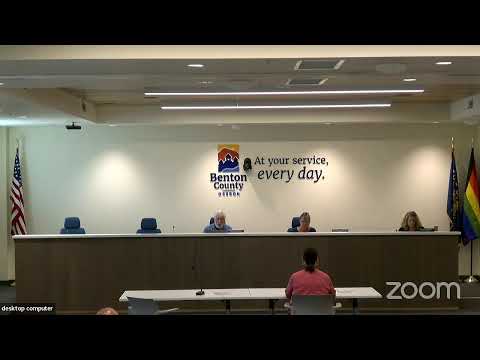
Brandon Persinger, representing the Association of Oregon Counties and the Council of Forest Trust Land Counties, briefed Benton County commissioners on statewide timber-harvest projections tied to a proposed Habitat Conservation Plan (HCP) created by the Oregon Department of Forestry and outlined three legislative options to address an estimated revenue shortfall.
Persinger said a 10-year historical average across 14 impacted trust-land counties is about 239 million board feet harvested annually; the Department of Forestry projects roughly 185 million board feet under the HCP — a decline of about 54 million board feet. Using a 10-year average stumpage price of $411 per thousand board feet, he estimated that reduction would translate into roughly a $22 million revenue decrease from state forest harvests.
Under current statute Persinger cited counties receive 63.75% of revenue from state-forest harvests (with the Department of Forestry retaining the remainder) and county shares are further allocated to county operations and school funds under ORS 530.110. Persinger said the governor’s office and county workgroup narrowed the options to three approaches:
- Option 1: Shift the percentage so counties/special districts/schools receive roughly 82% and the Department of Forestry receives about 18% (ODF bears the reduction).
- Option 2: Increase the Department of Forestry share to about 47% so ODF would receive roughly the same dollars it does now; that would reduce counties’ and schools’ combined share to roughly 53%.
- Option 3: Place the reduction primarily on school districts, moving impacted school funding onto the state equalization program so counties and special districts retain levels near current expectations.
Persinger underscored that each option carries legal and political tradeoffs and that statutory changes would be needed during the 2025 legislative session if counties want to avoid an unaddressed hole when the HCP takes effect. He asked the Trust Land Counties to provide a recommendation on a preferred option by mid-August.
For Benton County specifically, Persinger said the 10-year historical average harvest is about 3,000,000 board feet. Using the assumptions presented, he estimated Benton County annual receipts would be roughly $557,000 under Option 1, about $359,000 under Option 2, and about $719,000 under Option 3 (Persinger emphasized market prices and harvest volumes affect these figures).
Commissioners discussed the options and potential political realities. Chair Zan Oshiro said she leans toward Option 3, noting education funding is likely to be front and center in the next legislative session and might be easier to backfill at the state level than county or ODF revenue; County staff echoed that view. Persinger offered to return with answers to follow-up questions and staff requested a concise packet summarizing the numbers and tradeoffs for legislative outreach.
Next steps: Persinger said Trust Land Counties will reconvene to consider positions and the governor’s office has requested recommendations by mid-August ahead of the 2025 legislative session.