Get Full Government Meeting Transcripts, Videos, & Alerts Forever!
Get email alerts on the Behavioral Health Deflection topic
No spam. Unsubscribe anytime.
Benton County outlines plan to stand up behavioral health deflection program with $231,000 from HB 4002
Summary
County staff and partners reported progress on a behavioral health 'deflection' program funded by House Bill 4002 (~$231,000 to Benton County), described eligibility and services, and set a tentative operational date of Jan. 1, 2025 pending final Criminal Justice Commission allocations and hiring a program coordinator.
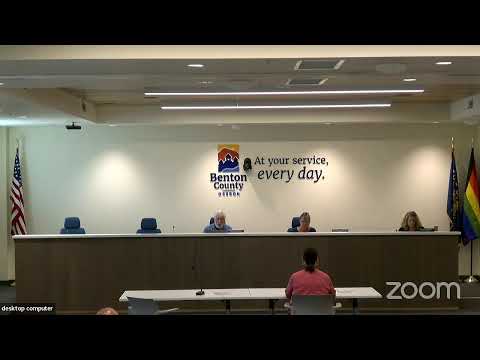
Benton County commissioners heard a multi-agency update Wednesday on plans to use a one-time state appropriation from House Bill 4002 to launch a behavioral health deflection program aimed at diverting people with low-level substance-related offenses away from the criminal-justice track and into services.
Rick Krager, who has been coordinating the county’s work on the grant, told commissioners the county’s short application to the Criminal Justice Commission cleared an initial 50% review and the full application was submitted on July 1. Benton County is scheduled to receive about $231,000 under HB 4002, Krager said, and the money is intended primarily to establish a program coordinator position and the infrastructure to coordinate law enforcement, the district attorney’s office, and behavioral-health partners.
Krager described a draft workflow that county staff and partners developed during four planning meetings. Under the current framework, eligible participants would be Benton County residents cited for misdemeanor possession of a controlled substance, with no history of violent crime or sex-offender status, no outstanding out-of-county warrants and no victims owed restitution. Participation would be voluntary and intended to occur quickly after citation — Krager said the draft goal is to connect people with assessment and supports within seven days.
April Holland of the county health department emphasized the program’s goal of matching services to need. "For lower-risk individuals, that might be counseling or education; for higher-risk cases we want peer navigation and comprehensive assessment to identify housing, insurance and treatment needs," she said.
Sheriff Jeff Van Orstall and the county’s district attorney praised the collaborative process. Van Orstall said he supports placing a coordinator in the health department to reduce the administrative burden on law enforcement and county staff. The district attorney underscored that higher-need cases will raise costs and that partners must align on what constitutes "success" for a deflection outcome.
Krager said the county expects a final Criminal Justice Commission allocation decision to occur around Aug. 1 and is targeting a tentative operational launch of Jan. 1, 2025. He added that he aims to post a recruitment packet for the program coordinator by Aug. 1 but cautioned that the position may face stiff competition from other counties.
Commissioners and staff discussed sustainability beyond the one-time HB 4002 appropriation. Krager and other presenters pointed to potential braided funding sources including opioid settlement allocations, Oregon Health Authority contract funds, federal grants such as Bureau of Justice Assistance programs, and resources held by community partners.
Chair Zan Oshiro and Commissioner Pat Malone asked staff for regular updates; Malone suggested a public communications plan to explain the program’s purpose and ties to Measure 110 reforms. Krager agreed to return with recruitment and operational updates and commissioners asked for a follow-up report in the fall.
Next steps: county staff will await the Criminal Justice Commission allocation, refine the draft workflow after the regional symposium and partner debriefs, post the program coordinator recruitment packet (target Aug. 1) and return to the board with an update prior to the planned Jan. 1, 2025 go-live date.