Get Full Government Meeting Transcripts, Videos, & Alerts Forever!
Get email alerts on the Labor Union topic
No spam. Unsubscribe anytime.
AFSCME members press Benton County for pay parity, staffing and safety during public comment
Summary
Dozens of AFSCME Local 2064 members told the Benton County Board of Commissioners that bargaining has stalled and urged the board to use reserves or additional funding for a ratifiable contract, citing pay gaps with non‑represented staff, unsafe crisis-team staffing and severe housing unaffordability.
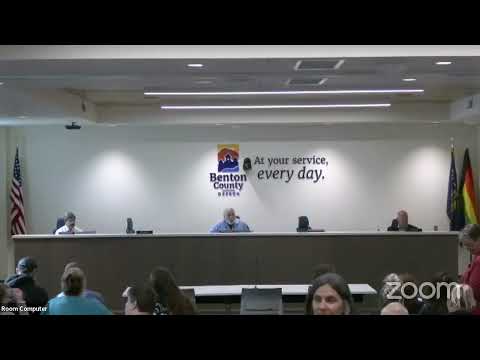
Dozens of county employees urged the Benton County Board of Commissioners on July 9 to act on stalled contract talks with AFSCME Local 2064, pressing for pay parity with non‑represented staff, retention pay for long‑tenured employees and safer staffing for mobile crisis response teams.
Dawn Dale, president of AFSCME Local 2064, told the board the union represents about 334 county workers and asked the commissioners to “authorize additional funding to help us come closer to a contract that will allow our membership to vote for and ratify,” including using reserves if justified. Dale said bargaining has been at a stalemate on economic and safety language since mid‑March.
Several frontline employees described the consequences of low pay and limited leave. Michelle Banks, the union vice president and a behavioral‑health housing coordinator, recounted cancer treatment that left her facing income shortfalls and told the board, “Please take care of your employees so that we can take care of our county.” Other speakers described relying on food banks, taking second jobs, long commute times and difficulty affording local housing.
Speakers repeatedly highlighted pay disparities between represented AFSCME positions and non‑represented staff. Public Works employee Joseph Moore cited years of salary‑schedule changes and told commissioners the result is a widening gap at both starting and top step pay levels. Several commenters pointed to recent management raises that union members said were far larger than the increases offered to represented workers.
Speakers also raised patient‑safety and legal compliance concerns for crisis services. Michelle Banks and Dylan Hanson said Oregon administrative rules require two‑person mobile crisis teams; Hanson said the county’s crisis program “is not staffed by the 2 professions that is legally obligated to be staffed by” and warned the county risks losing funds or contract oversight if staffing stays out of compliance.
The board took no immediate action in response to the comments; commissioners thanked speakers and said staff would bring the testimony into ongoing budget and bargaining discussions. The public‑comment period ran before the board’s later budget and labor items.
What’s next: union leaders said bargaining will continue and that AFSCME members may withhold ratification of any contract they consider inequitable.