Get Full Government Meeting Transcripts, Videos, & Alerts Forever!
Get email alerts on the Housing Production topic
No spam. Unsubscribe anytime.
Assembly committee reviews early results of California housing-production laws; officials cite gains and funding gaps
Summary
At an informational hearing, researchers, HCD and developers said ADU and streamlining laws have measurably increased permitted units and shortened approval timelines, while CEQA litigation risk, infrastructure costs and an acute funding gap remain barriers to turning entitlements into completed homes.
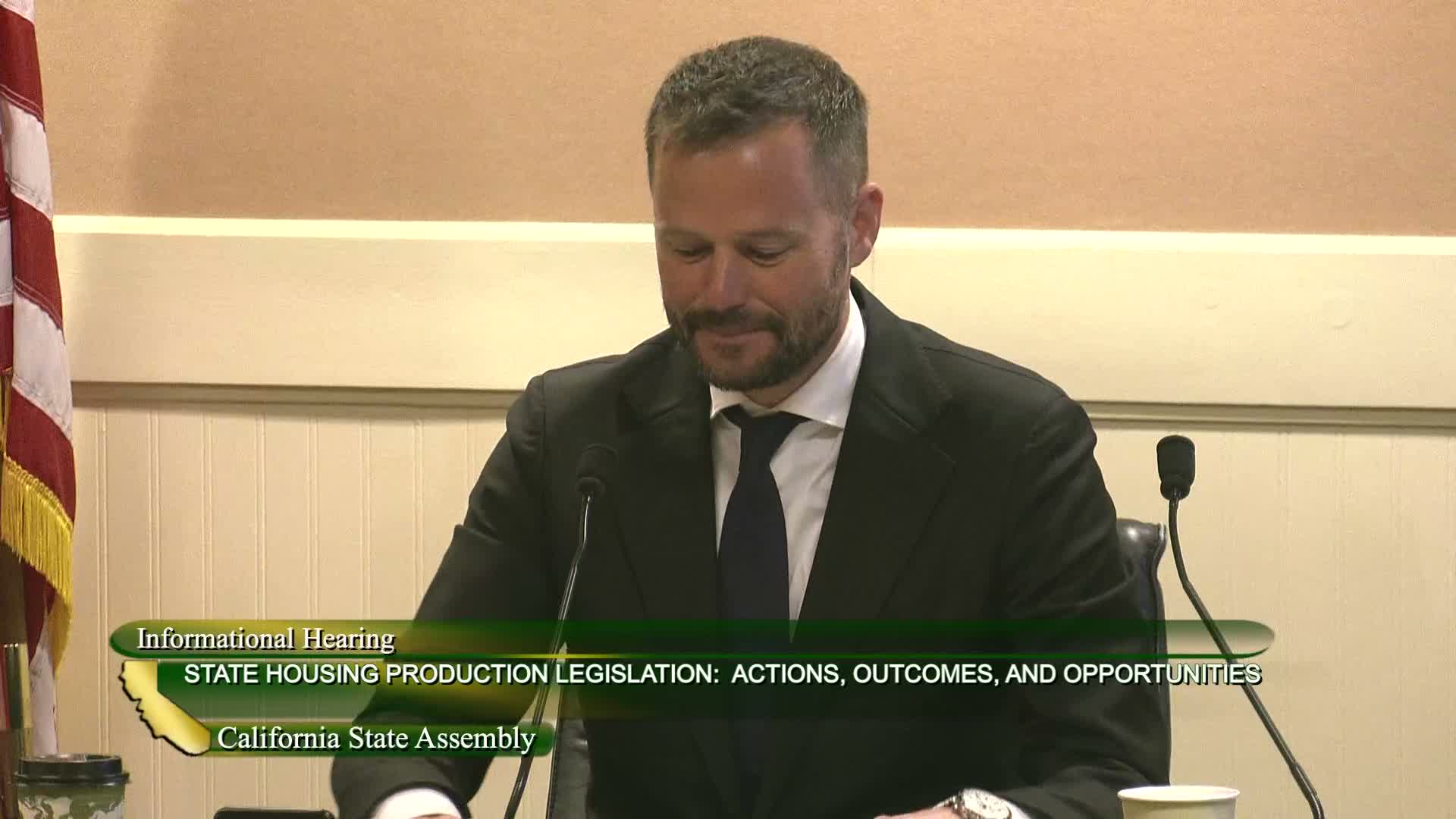
The California State Assembly Housing and Community Development Committee convened an informational hearing to assess the impact of recent housing-production laws and to identify next steps to convert permits into built homes. Chair Haynie opened the session by calling California’s housing situation a crisis, noting that rising costs are forcing many households to choose between rent and basic needs.
UC Berkeley Turner Center managing director Ben Metcalfe told the committee the state remains far off its RHNA targets: production per capita places California near the bottom nationally, and long-term permit levels are well below what would be needed to close the gap. Metcalfe cited restrictive local zoning, high development costs and front‑end fees as the main reasons California lags and pointed to two policy bright spots: accessory dwelling units (ADUs) and streamlining tools for subsidized affordable housing. He said ADU permitting rose from about 8,900 units in 2018 to more than 28,000 in 2023 and that streamlining (SB 35, now tracked as SB 423) has accelerated many projects into entitlement.
Megan Kirkety, deputy director for housing policy at the California Department of Housing and Community Development (HCD), described HCD’s implementation and enforcement role. HCD’s Housing Accountability Unit has grown and now fields complaint-based investigations and proactive housing-element oversight; Kirkety reported HCD has issued roughly 616 advisory letters and 17 notices of violation and credited complaint work with unlocking nearly 8,000 housing units (about 3,000 affordable). She said surplus-land reviews have identified nearly 32,000 homes tied to local land dispositions, with roughly 20,000 designated as affordable under deed restrictions.
Kirkety also presented statewide data showing completed residential construction up 13.1% from 2022 to 2023, a fall in average application-to‑entitlement time from about 145 days (2018) to 64 days (2023), and a notable increase in deed‑restricted affordable-unit entitlements since 2021. She emphasized HCD’s APR dashboard and annual progress reports as public, machine-readable sources of local compliance and permitting data.
Developers and local officials described how streamlining and planning grants have produced a larger pipeline but identified persistent bottlenecks. A land-use attorney and developer panelist recounted a Livermore project that complied with a prior specific-plan environmental review yet faced litigation that delayed financing and construction for years, illustrating how CEQA challenges can defeat otherwise eligible projects. Panelists also highlighted an acute funding shortfall: state programs and competitive funds are oversubscribed, and many projects that clear entitlement cannot secure the subsidies or loans needed to close financing. Infrastructure costs (water, sewer, drainage), high insurance and labor shortages were cited as additional constraints that raise per‑unit costs and limit feasibility.
Committee members asked about local accountability under RHNA, the midpoint production trigger (50% progress), and whether additional streamlining should be extended to market-rate projects. HCD said the APR dashboard is updated annually (with corrections allowed) and that percentage-based checkpoints can activate additional streamlining for jurisdictions that fail to meet production milestones.
Public commenters urged the legislature to fund affordable-housing programs and explore homeownership tax credits targeted to underrepresented communities. Chair Haynie closed by inviting legislative proposals informed by the hearing and said the committee will continue oversight as members craft policy and budget options.
What’s next: lawmakers and HCD said they will continue enforcing housing-element commitments, expand technical assistance to under-resourced localities and pursue budget and legislative options to increase funding and reduce the remaining procedural and financial barriers that stall construction.