Get Full Government Meeting Transcripts, Videos, & Alerts Forever!
Get email alerts on the Jayhawk Theater topic
No spam. Unsubscribe anytime.
Jayhawk Theater asks Shawnee County to match $5 million state grant to finish critical infrastructure
Summary
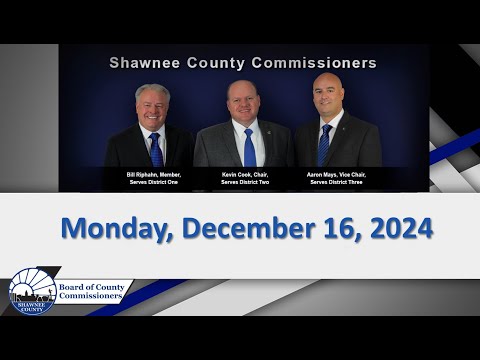
Jayhawk Theater representatives told the Shawnee County Board of County Commissioners on Dec. 16 that life‑safety, accessibility and mechanical upgrades exceed $15 million and asked the city and county to match a $5 million state Sprint grant so work can continue; commissioners asked for clearer line‑item budgets and offered support but took no vote.
Joanne Morel, speaking for the Jayhawk Theater, told the Shawnee County Board of County Commissioners on Dec. 16 that the restoration project is moving quickly but still needs local support to secure full funding.
Morel said the most urgent work—accessibility, life‑safety, structural and MEP upgrades—“totals more than $15,000,000 alone,” and that the project has received a $5 million Sprint grant from the state. “What we need and what we’re asking is for the city and county to work together to match the state’s commitment of $5,000,000,” she said, adding that a local match would “keep our construction in full motion” and help leverage other funding opportunities.
Why it matters: presenters said the Jayhawk’s reopening would expand Downtown Topeka’s cultural and tourism offerings, fill a mid‑size venue niche, and generate visitor spending that benefits local businesses. Morel said reopening in 2026 would mark the building’s 100th anniversary and argued that restored operations could support multiple nights of programming per week.
Details and budget questions
Architect Vance Kelly and board president Jeff Carson answered commissioners’ technical and budget questions. Kelly described site constraints—an alley that channels water to the foundation, high‑voltage and telecom lines, and asbestos abatement needs—that have required careful, often hand‑excavation work. He said the construction manager (Seni and Company) is handling masonry restoration and waterproofing before interior restoration continues.
When asked about budget lines, presenters said roughly $3.8 million of earlier phase funds have gone to architectural and engineering and interior/exterior restoration work and that about $220,000 remained in contingency for those early packages; they also said the project’s master budget is being refined and that they would provide updated line‑item figures. Morel summarized that phase‑one critical infrastructure items totaled about $11,500,000 with an approximate remaining balance of $5,000,000 after other funding is accounted for. Presenters described the $5,000,000 historic preservation tax‑credit estimate as a projected, end‑of‑project credit rather than an immediate cash source.
Accessibility, operations and phasing
Commissioners pressed on ADA and code requirements. Kelly said there are no blanket exemptions from ADA or life‑safety codes for historic buildings but noted the project team has developed phased, site‑specific solutions intended to restore broad accessibility while preserving historic fabric. On operations, presenters said the building cannot simply revert to prior, limited use after phase 1; additional infrastructure funding will be needed to return to full programming and to begin booking artists for a planned 2026 reopening.
Local context and prior investments
Speakers reviewed prior local grants and work: an earlier JADO Quality of Life request produced partial funding—about $53,000—for a sewer line extension and other small projects that made subsequent work possible. Molly Howie and other local stakeholders were acknowledged for prior assistance.
What happens next
Commissioners thanked the presenters and said they were supportive; no vote or formal commitment was made during the work session. Presenters asked the county and city to consider phased or partial funding so construction can continue without delay and said they would supply updated budget detail on request.
Quotes
“Once restored, we will quadruple our seating capacity,” Joanne Morel said, describing the building’s potential for increased programming and visitor draw. Vance Kelly described the site work and constraints: “we are dealing with a building that, has an alley that allows water to run to the building and in the building.”
Ending
The commission will consider the request; presenters requested local matching funds to leverage the state Sprint grant and to complete critical infrastructure. No formal action was taken at the Dec. 16 work session.