Get Full Government Meeting Transcripts, Videos, & Alerts Forever!
Get email alerts on the Municipal Budget topic
No spam. Unsubscribe anytime.
Austin council recommends sending proposed $9.8 million 2025 levy to final approval
Summary
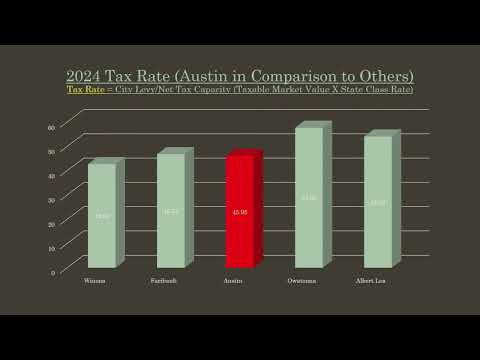
At a Dec. 4 Truth-in-Taxation hearing, city staff presented a proposed $49.8 million 2025 budget and asked the council to recommend a $9.8 million tax levy (an 11.97% increase); the council voted to send the levy to final approval on Dec. 16.
At a Dec. 4 Truth-in-Taxation hearing, city staff asked the Austin City Council to recommend a proposed $9,800,000 tax levy for 2025 and a $49.8 million overall budget. Council members voted by voice to send the proposal to the council’s Dec. 16 meeting for final approval.
City staff summarized the proposal as a balanced budget and described its development process. “The proposed tax levy for 2025 has been worked on, by staff and department heads,” said Tom, the staff presenter. He told the council the general fund is proposed at $22,500,000 and that the levy increase is roughly 11.97% over the 2024 levy.
Staff said the city expects roughly $9.8 million in Local Government Aid (LGA) next year, which they described as about 44% of the general fund. The proposed levy would allocate about $6.7 million to general operations (police, fire, administration and streets), $1.3 million to the library, $40,000 to the Port Authority and roughly $1.7 million to the capital improvement revolving fund, primarily for street work and hazardous building removal.
The budget would add three full-time-equivalent positions paid from tax levy: a housing code enforcement officer and a human-resources generalist; the wastewater treatment-plant operator position would be paid from sewer user fees. Staff said personnel costs account for about 68–69% of general-fund expenditures and have been rising.
During questioning, a council member pressed staff on the city’s health-insurance reserve. “But if your premium's a million and a half, why do you have a surplus going into a premium year of 2 and a half to $2,300,000?” the member asked. Tom replied that the amount reflects employer premium allocations from departments, employee contributions and HSA contributions and said he would review the numbers again: “I’ll take another look at that.”
Staff also flagged a recent rise in workers’ compensation costs linked to PTSD-related claims, saying workers’ compensation increased by nearly $400,000 this year and is expected to pressure next year’s budget unless there is policy or statutory relief.
Staff estimated the typical owner of a $150,000 home would see a city tax bill of about $689 under the proposed levy. Council members and staff discussed trade-offs between personnel costs, capital needs and keeping a robust year-end fund balance; staff reported a 57% fund-balance level at the end of the last year and said the city aims to maintain 42–48%.
At the end of the hearing, a council member moved to recommend the proposed levy for final approval on Dec. 16; Paul seconded. The council approved the recommendation by voice vote with no opposition recorded. Council members also approved a staff-requested resolution removing a previously planned tax levy associated with utility improvement bonds, because the utility has revenue to pay its debt.
The council is scheduled to consider the final levy and budget on Dec. 16, when it may adopt the tax levy that will be filed with the county and the state.