Get Full Government Meeting Transcripts, Videos, & Alerts Forever!
Get email alerts on the Land Use Rezoning topic
No spam. Unsubscribe anytime.
Fort Myers Beach planners approve food-truck park with conditions after debate over noise, hours and buffers
Summary
After hours of public comment and debate, the Fort Myers Beach Local Planning Agency approved a conditional planned development (CPD) allowing a five-pad mobile vendor/food-truck park with 27+ conditions—covering buffers, restrooms, parking surface, hours, music and compliance reporting—by a majority vote.
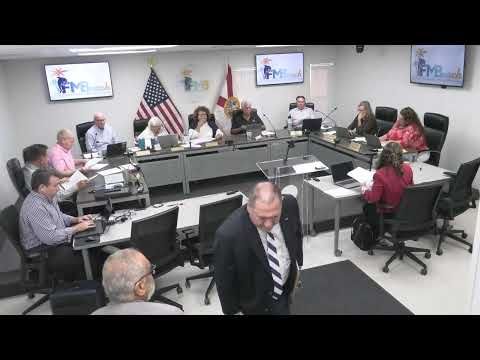
The Local Planning Agency for the Town of Fort Myers Beach voted to approve a conditional planned development allowing a mobile vendor/food-truck park on Estero Boulevard after extended public comment and a lengthy discussion of noise, traffic, buffers and enforcement.
The motion, made by Jim and seconded by Doug, passed after the panel weighed staff recommendations, neighborhood testimony and applicant assurances. Staff principal planner Judith Frankel said the town’s land-development code does not specifically address food-truck parks, which is why the CPD process was used to write site-specific regulations. "The code does allow for the commercial development process, which is what we're in now," Frankel told the LPA, and she listed the six deviations and a set of conditions recommended by staff.
Why it matters: The proposal replaces a previously vacant, hurricane-impacted parcel with a commercial concept that members said is "less intense" than earlier entitlements but more potentially intrusive to adjacent residents because it is open-air. Neighbors warned the proposal could hurt property values and generate nuisance noise; Pelican Watch owner Randy Bryce said realtors and prospective buyers already reported changed interest after the project was publicized.
Staff recommended a long list of conditions intended to reduce nuisance and public-safety risks, including required buffers and plantings along Chapel Street, Cottage Avenue and abutting parcels; a maximum of five mobile vendor pads plus one permanent support structure not to exceed 2,500 square feet; prohibition of cannabis- or smoke-related merchandise vendors; alcohol consumption limited to beer and wine; restrooms built to Florida Building Code requirements; and limits on parking-surface materials with a required grid or semi-pervious paver system. Frankel also said the staff draft allowed outdoor amplified music until 9 p.m. only in designated entertainment areas and limited to solo or duo performers unless a special-event permit is obtained.
Neighborhood concerns centered on contact and consultation, site access, public restroom safety and the potential for amplified music. Derek O'Loughlin, who lives at 2553 Cottage Avenue and said he is the closest resident to the proposed trash enclosure and restrooms, told the LPA: "The applicant has never contacted me whatsoever." Residents also raised the prospect of restrooms being used overnight; in response staff clarified restrooms must meet the Florida Building Code and the draft condition requires restrooms be closed after hours.
The applicant's team, represented by Ken Galander and attorney Noel Davies, disputed claims about intensity and impacts and said the project is less intense than previously entitled development. Galander referenced an approved trip-impact study associated with a 2008 CPD and said the applicant will provide a trip-generation comparison at time of development order; Davies urged the LPA to weigh staff and expert testimony with the same weight as lay testimony.
Music and generators drew particular attention in debate. Some board members favored prohibiting live amplified music; others said amplification could be managed by containing entertainment within a roofed, three-sided structure and orienting speakers away from residences. The LPA reached consensus language to clarify that amplified sound should originate from the designated enclosed entertainment area and discussed operational limits on generator use, with generator operation generally limited to emergency or temporary events and the applicant required to provide on-site utilities.
Enforcement and compliance measures were added to the conditions discussion. Several members recommended owner-driven compliance reporting — quarterly for an initial period — so the town has scheduled checkpoints to verify noise, trash and other conditions are being met. "I think there ought to be some prearranged... quarterly compliance and reporting back to whatever department," one member said, arguing the requirement puts the onus on owners rather than continuous staff enforcement.
The final motion directed staff and the town attorney to draft formal CPD conditions incorporating the changes discussed in the hearing. The motion was moved by Jim, seconded by Doug, and carried by a majority of the LPA; the chair acknowledged residents' concerns and encouraged cooperation as the project moves to the development-order stage.
What's next: A local development order will be required before site work can proceed, and staff said additional items such as a small-scale traffic study, the detailed master-concept exhibit showing designated entertainment areas, and the compliance/monitoring schedule will be finalized at that stage.
Representative quotes from the hearing: "The applicant has never contacted me whatsoever," said Derek O'Loughlin, a nearby resident. "The code does allow for the commercial development process, which is what we're in now," said Judith Frankel, principal planner. The applicant's attorney, Noel Davies, told the panel: "We are asking for less and to boot, we're providing... public restrooms."
The LPA moved on to other agenda items after the vote; the approval is subject to the formal written CPD conditions and a subsequent development-order approval.