Get Full Government Meeting Transcripts, Videos, & Alerts Forever!
Get email alerts on the Area 3 Farmland topic
No spam. Unsubscribe anytime.
Debate over Area 3 farmland and urban reserves continues as staff weighs legal tests and a 60‑acre rezoning
Summary
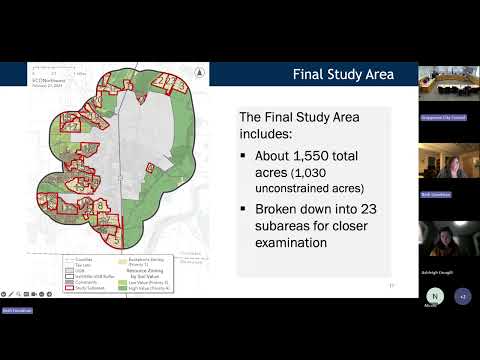
Council and planning commissioners discussed whether to include Area 3 — a partly high‑value farmland parcel near Highway 30 — in urban reserves. Staff said OAR‑based priority rules limit when farmland can be included; a potential 60‑acre Parker Pit rezone could reduce the need to take farmland into reserves.
City planners and the consultant pressed councilors and commissioners to weigh the tradeoffs of including Area 3 in Scappoose’s urban reserves.
Beth Goodman described Area 3 as "pretty big and unconstrained" and noted it includes about 15 acres of high‑value farmland adjacent to Highway 30. She said the parcel is attractive because services are nearby, which would make it cheaper to serve than some other study areas.
City attorney Ashley and staff cautioned that Oregon’s statutory priority scheme and the Oregon Administrative Rules (OARs) restrict jumping to high‑value farmland before exhausting higher‑priority exception lands. Ashley said urban reserves can include farmland only under two limited OAR exceptions: where higher‑priority land is physically or topographically constrained or where including lower‑priority land would clearly maximize efficient use of higher‑priority land.
Councilors asked practical questions about how small a parcel could be brought in and whether a narrow “cherry stem” connector would be acceptable. Goodman said she generally advises against creating long, narrow urban extensions because they produce poor urban form, but acknowledged that a targeted connector might be an option if the council chooses that route.
Staff also briefed the group on a separate development that could change the calculus: a property owner is discussing rezoning roughly 60 acres of the Parker Pit from industrial to commercial. Lori Oliver Joseph said that rezoning would require a Transportation Planning Rule analysis with ODOT and might be subject to interim trip caps; if that 60‑acre site were redesignated and counted in capacity assumptions, the city’s need for new UGB acreage could fall by an estimated 20–30 acres. Goodman said staff will pursue DLCD and TPR guidance and that, for now, the council should keep Area 3 on the table pending those answers.
The meeting produced no formal vote; the council and commissioners signaled support for retaining Area 3 as a candidate while staff completes legal and technical follow‑up and prepares clearer maps for public review.