Get Full Government Meeting Transcripts, Videos, & Alerts Forever!
Get email alerts on the Economic Development topic
No spam. Unsubscribe anytime.
County economic team presents business-survey findings; Scappoose highlighted for retention and land challenges
Summary
Sierra Trast of the Columbia economic team told the Scappoose City Council on Oct. 21 that a countywide Business Community Connection Project completed 75 interviews and identified workforce, customer base and land availability as top business concerns; Scappoose-specific data show mixed employment trends and strong participation.
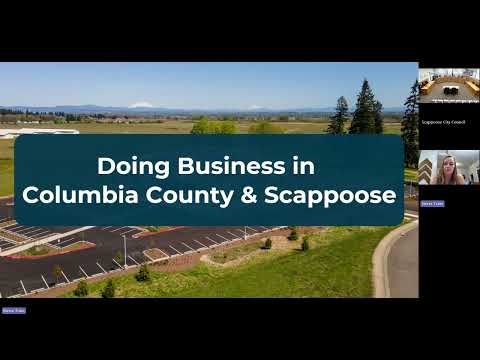
Sierra Trast, identified in council remarks as a small business specialist with the Columbia economic team, presented findings from the Columbia County Business Community Connection Project at the Scappoose City Council meeting on Oct. 21.
"The heart of this project is really to hear from business owners," Trast said, describing a countywide effort that combined interviews, surveys and local data. The project completed 75 one-on-one interviews, engaged 55 volunteers and worked with about 25 partner organizations, she said. Trast told the council 24 Scappoose businesses participated in the study and that "27% of businesses in here in the county are in Scappoose." The countywide dataset she cited reported roughly 1,587 establishments.
Why it matters: the results are intended to shape a countywide economic strategy and local action teams. Trast said the interviews surfaced problems likely to affect Scappoose’s growth, including difficulty finding customers, shortages of skilled labor and obstacles to accessing land and suitable commercial buildings.
Key findings presented to the council included: businesses most frequently cited workforce and customer-base shortfalls; many owners reported competing labor markets in larger nearby cities; capital access (startup and small-business loans) and broadband were widespread sources of dissatisfaction; and Scappoose respondents singled out regulatory and permitting hurdles, wetlands constraints and a shortage of ready-to-build commercial parcels as particular barriers.
Trast emphasized workforce and training gaps. Employers ranked expanded CTE programming in high schools and more vocational training as high priorities. She also shared commuting data showing a net daily outflow of workers, saying about 6,000 jobs are held by people who live in the county, roughly 4,600 jobs are filled by people commuting in, and about 18,000 residents leave the county daily for work — figures she used to explain why local customer bases are constrained.
Trast described a set of recommended solutions that emerged from the task force and business interviews: more CTE programming, downtown revitalization efforts, campaigns to encourage local shopping, enhanced advocacy for businesses at the local and state levels, and programs to develop or restore commercial buildings. She said the task force has identified four focus areas and plans to form action teams to pursue priorities over the next one to five years.
Council members asked about task force membership and local representation; Trast said Scappoose had strong participation and that city staff and the Port of Columbia County were among partners. She offered to send four written reports — a countywide summary, a city breakdown (including a Scappoose-specific report), a workforce report and business profiles — to the city manager for distribution.
Next steps: the council will receive the written reports for local review and staff said the task force will continue meeting periodically to track progress and prioritize actions.