Get Full Government Meeting Transcripts, Videos, & Alerts Forever!
Get email alerts on the Floodplain Policy topic
No spam. Unsubscribe anytime.
Coos Bay picks Pathway 4 for FEMA NFIP‑ESA rules and adopts resolution exempting routine activities
Summary
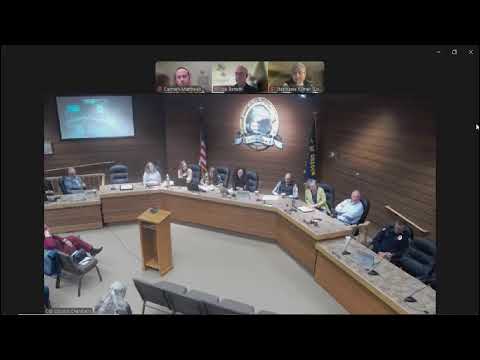
The City of Coos Bay voted to implement Pre‑Implementation Compliance Measure Pathway 4 under NFIP‑ESA guidance and adopted Resolution 24‑34 to exempt listed routine activities from habitat assessment requirements; council discussed legal uncertainty and the option to participate in multi‑jurisdiction litigation against FEMA.
The Coos Bay City Council voted to implement Pre‑Implementation Compliance Measure (PICM) Pathway 4 under the National Flood Insurance Program–Endangered Species Act (NFIP‑ESA) guidance and adopted Resolution 24‑34 exempting certain routine activities from habitat‑assessment requirements.
Chelsea, the city’s planning/staff presenter, explained Pathways 1–3 (model ordinance, permit‑by‑permit mitigation, and prohibition of development) and the alternative Pathway 4, which relies on the city’s existing floodplain code (44 CFR 60.3) and on ESA incidental‑take permitting procedures. Staff said Pathway 4 is a less intrusive course for local permitting because it does not, at present, require a city code amendment and could be implemented quickly to meet the federal reporting deadline.
Councilors raised legal and practical concerns. Council President De Novo and others noted Pathway 4 is not explicitly approved under FEMA’s Section 7 consultation and carries the risk that future federal rulemaking could require different standards. Nate McClintock (counsel) told the council he had reviewed FEMA statutes and would recommend Pathway 4 as consistent with existing authority but warned that FEMA could later adopt habitat assessment/no‑net‑loss standards and require communities to change course.
Despite uncertainty, councilors emphasized the need to preserve local development capacity—citing potential impacts to housing and commerce—and to avoid immediate disruptions to permitting and flood‑insurance availability. The council also discussed a separate request from outside attorneys/jurisdictions inviting cities to participate in coordinated litigation and legislative advocacy against FEMA biological opinions; councilors expressed interest in learning more and asked staff to return with details on litigation participation and potential costs.
Council voted to implement Pathway 4 and adopt Resolution 24‑34 (exempting listed routine activities); the motion carried by voice vote.
What’s next: staff will report the selection to FEMA, publish revised permitting materials and an exemption list by policy resolution, and provide additional information about possible litigation participation at a future meeting.