Get Full Government Meeting Transcripts, Videos, & Alerts Forever!
Get email alerts on the Emergency Preparedness topic
No spam. Unsubscribe anytime.
Depot Bay committee advances neighborhood 'barrel' caches, schedules vendor briefing and radio test
Summary
Depot Bay’s emergency‑preparedness committee agreed to move forward with planning a pilot ‘barrel’ cache program adapted from nearby towns, signaled procurement and funding tasks, and scheduled a vendor briefing and a radio test on Dec. 7 to exercise local communications.
Depot Bay’s emergency‑preparedness committee on Nov. 18 advanced planning for a neighborhood emergency cache program that would place sealed containers of 72‑hour supplies at volunteer homes and public sites, discussed site constraints at a proposed Stonebridge location, and scheduled vendor and communications tests to firm up costs and logistics.
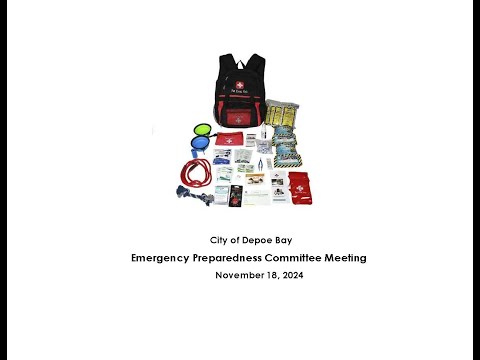
Committee members described a locally adapted “barrel” approach modeled on programs in nearby Seaside and Lincoln City. Deb and Joyce, who led the proposal, said the idea is to use airtight 50‑gallon containers or equivalent sealed storage at volunteer locations so neighbors and visitors have immediate access to water, food and basic medical supplies for the first 72 hours after an incident. “This is for about 72 hours for for 200 people,” one presenter summarized in describing the pilot’s target coverage.
Why it matters: the program is intended as a supplement to formal city caches and to give neighborhoods something tangible while planners pursue larger cache (or “cash”) sites. Committee members emphasized that the barrel program is not a substitute for a permanent city cache but rather a lower‑cost, community‑hosted complement that could raise public awareness and buy time while more permanent solutions are developed.
What the committee decided and next steps - Planning milestone: committee members agreed to continue planning toward a March target for a pilot rollout and asked the barrel team to return with estimated costs, a proposed contents list and a plan for sourcing containers. One member told the committee that purchase prices found so far were as high as about $119 per unit from some vendors, and that donated options should be pursued but may require time to secure. - Vendor briefing: the committee asked staff to invite Ready/Red America (vendor contacts used by neighboring cities) to present supply packages and pricing at the next meeting; the chair confirmed, “We’ll have Ready America time at the next meeting.” - Communications test: the group scheduled a radio roll‑call and coverage test for 9 a.m. Saturday, Dec. 7 on channel 15 to evaluate reach from the emergency operations center and the committee’s new radio site; the committee encouraged residents with radios to tune in so the radio team can confirm reception.
Costs, roles and legal considerations Committee members discussed funding options and limits. The group noted it is not a 501(c)(3) and so donations to the city are not tax‑deductible, explained that household volunteers could host a cache but that donations or fundraising must be coordinated with city finance rules, and flagged that some project costs (for example, a wetland study later described) could fall to the committee. “It just comes out of your budget,” one member cautioned when discussing volunteer‑hosted repairs and upgrades to fire cache storage.
Site constraints: Stonebridge under review The committee reviewed a city engineer’s report on a possible Stonebridge cache site and learned the parcel lies in a riparian/wetland area. Members said a wetland delineation and state permitting may be required and that commissioning an updated study could cost “a couple thousand dollars.” The engineering finding prompted discussion of alternative sites (city‑owned lots, parking areas, or leased storage) if permitting makes Stonebridge impractical.
Technical choices and inventory Members debated container types and maintenance: airtight 50‑gallon barrels were proposed, but lighter sealed totes or heavy‑duty trash cans with moisture absorbers were discussed as alternatives. The committee agreed on regular checks (suggested every six months) and on designing contents for at least the first 72 hours (water, protein bars, basic medical supplies, lighting and sanitation). The group also discussed shelf‑life management and options for donating expiring supplies to local shelters or partners.
Community outreach and event planning Committee members proposed a community emergency‑preparedness event targeted for March (with speaker panels, agency briefings and demonstrations) to raise participation and explain volunteer roles. The group recommended inviting local emergency responders and volunteers with first‑hand disaster experience to make the event practical and compelling to residents.
What’s next: the barrel team will return with a procurement/cost estimate, a recommended contents list and a proposed distribution/pilot plan ahead of the March milestone; staff will invite Ready/Red America to present specific packages and pricing at the next meeting; and the radio committee will carry out the Dec. 7 channel‑15 coverage test.