Get Full Government Meeting Transcripts, Videos, & Alerts Forever!
Get email alerts on the Telecommunications topic
No spam. Unsubscribe anytime.
Bluffdale council rejects text amendment to allow Starlink gateway at main city entrance
Summary
After a public hearing and technical Q&A, the Bluffdale City Council voted down an ordinance to allow a Starlink satellite communications facility on the city’s gateway parcel, citing concerns about visual impact, future development compatibility and uncertainty about radio‑frequency exposures.
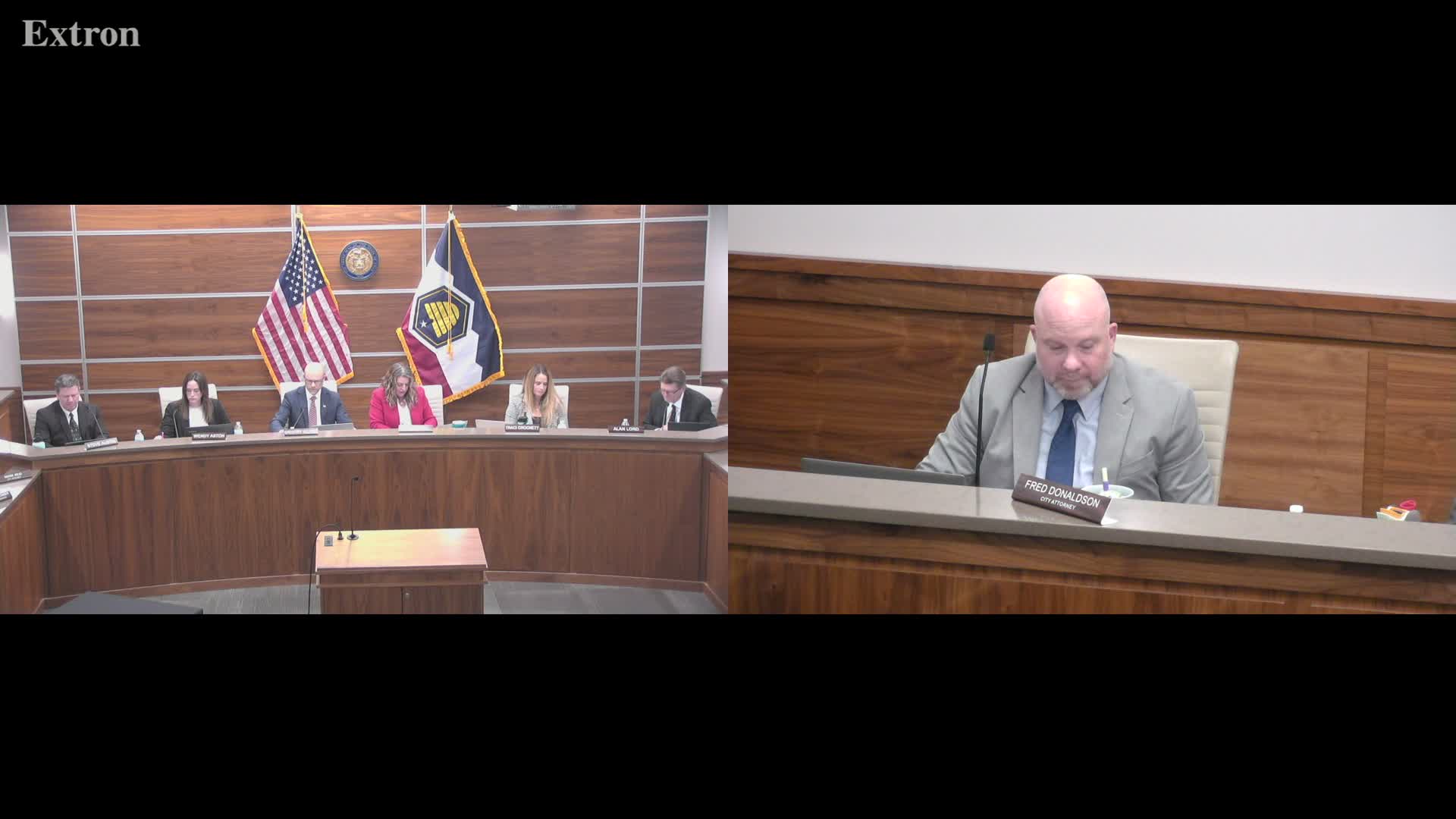
A proposed change to Bluffdale’s zoning code that would have allowed a Starlink "satellite communication station" on a 6‑acre gateway parcel failed in a roll‑call vote by the City Council on Dec. 12, 2024.
Planning staff presented the request as a text amendment to the SDX Gateway zone to add a definition for satellite communication stations and to permit such uses up to a half‑acre (27,780 square feet). The applicant sought to lease a portion of a parcel already entitled for a full‑service hotel and up to 500 residential units. The Planning Commission had forwarded a positive recommendation on Nov. 6, with conditions including a third‑party review of the radiation impact analysis, masonry fencing and perimeter landscaping to match public utility substation standards.
During the council hearing, members questioned siting the installation at the city’s primary entrance. One councilmember said placing a fenced field of antenna at the gateway would complicate future development of that high‑visibility parcel and could make the area harder to develop as intended for hotel and residential uses.
Councilmember Austin raised technical concerns about the submitted radiation impact analysis. Reading from the report on permissible exposure limits, Austin noted how the analysis calculated exposure for a single dish and cautioned that the proposed site plan with roughly 40 antennas could change the aggregate field and the off‑axis exposure profile.
John Fazio, the applicant participating by phone, responded: “I am not an RF engineer,” and said the analysis and installations of similar scale are governed by federal FCC standards; he added that Starlink would operate remotely and could pause transmitters during maintenance and that signage and access controls would keep the public from entering the enclosure.
Council discussion focused on two practical points: (1) whether the proposed use was compatible with the gateway’s long‑term development objectives and visual character, and (2) whether the radiation analysis and its assumptions (number of antennas, beam angles and future surrounding development) had been independently verified. Planning staff confirmed they had asked the applicant for additional documentation and had tried to obtain third‑party review resources for the council but had not secured an outside RF expert in time for the hearing.
After deliberation, a motion to approve Ordinance 2024‑26 failed on a roll‑call vote. The council did not adopt the text amendment; the Planning Commission’s recommendation and suggested conditions therefore did not become zoning code.
What’s next: The applicant may revise the proposal, supply further independent technical reviews, or pursue alternative sites. Councilmembers said any return of the item should include third‑party verification of the technical analysis and clearer design commitments for fencing, masonry screening and landscaping.