Get Full Government Meeting Transcripts, Videos, & Alerts Forever!
Get email alerts on the Public Safety Telecom topic
No spam. Unsubscribe anytime.
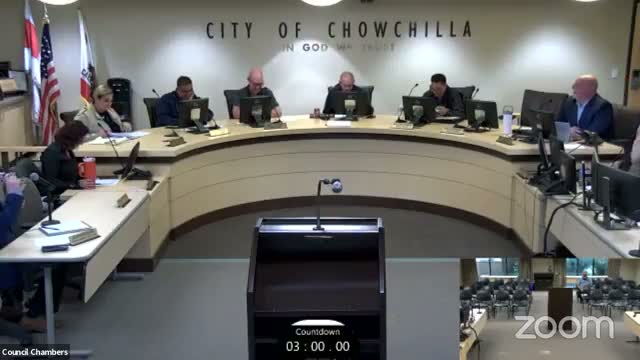
Council debates Edward Ray Park communications tower, directs staff to get monopole pricing and mock-ups
Summary
Council discussed three tower types for Edward Ray Park—an a-frame, a standard monopole and a camouflaged monopole 'tree'—heard Verizon interest in building in exchange for lease payments, and directed staff to pursue monopole pricing and visual mock-ups to balance functionality and aesthetics.
The Chowchilla City Council discussed construction of an emergency-services communications tower at Edward Ray Park and directed staff to return with pricing and visual mock-ups for a conventional monopole design.
Mister Rogers, identified as city staff (first speaking SEG 141), said police and fire requested the tower to support additional security cameras and to improve emergency communications citywide. Staff described three options: an a-frame (taller, higher capacity), a standard monopole (smaller footprint and aesthetically neutral) and a camouflaged monopole 'tree' (visually screened but capacity-limited). "We had asked... they said that they would build it in lieu of 10 years of lease payments," an attendee relayed about Verizon's outreach (SEG 468–476), summarizing a vendor proposal to construct the structure in exchange for a decade of lease revenue.
Council members emphasized public-safety requirements when evaluating options. One councilmember said the city should reserve the top portion of any tower for police and fire radios to maximize range, noting some radios do not reach their residences. The same speaker said a city-built tower could host multiple carriers and speed up payback through leasing revenue.
Concerns and trade-offs raised in the meeting included: - Functionality versus aesthetics: staff warned that camouflage tree monopoles can obstruct camera fields of view and usually have higher maintenance costs; an a-frame can hold more equipment but may be visually intrusive and invite climbing. - Procurement threshold: staff noted that a public-works project under $200,000 would not require formal bidding; some preliminary estimates for the camouflaged monopole reached as high as $350,000, which would trigger a formal bid. - Vendor proposals and lease rates: staff cited example lease-rate ranges of $400–$1,800 per month nationally and $1,200–$3,000 per month in California city examples, and said a Verizon offer would equate to roughly $3,000 per month in the local example discussed.
While Verizon expressed interest in leasing space or building the tower and later donating it to the city, councilmembers repeatedly stressed that public-safety communications must not be constrained by carrier priorities. One councilmember recommended that the city pursue building a monopole to retain control and maximize long-term capabilities and potential for multiple carriers.
The council did not take a formal vote. Instead, members directed staff to obtain pricing and mock-ups for the preferred monopole option, and to return with recommendations (direction recorded; no action to approve construction was taken).