Get Full Government Meeting Transcripts, Videos, & Alerts Forever!
Get email alerts on the Infrastructure Wastewater topic
No spam. Unsubscribe anytime.
Chowchilla approves up to $7 million reimbursement agreement with High Speed Rail to advance Fairmead sewer consolidation
Summary
Council authorized a reimbursement agreement allowing up to $7 million from the California High Speed Rail Authority to be used for design work on the Fairmead Sewer Consolidation Project; staff said the State Water Resources Control Board funding (about $15.05M remaining) would cover construction while this agreement allows engineering costs to be reimbursed now.
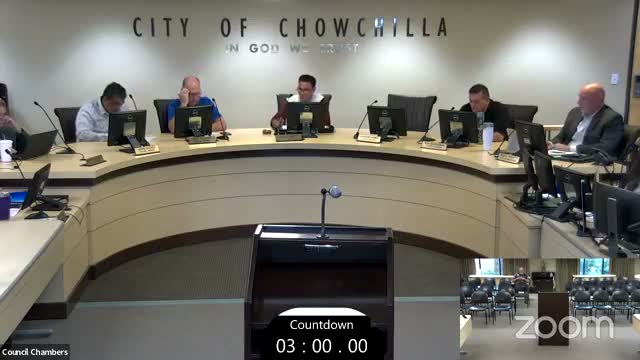
The Chowchilla City Council voted to authorize a reimbursement agreement with the California High Speed Rail Authority that will allow the city to receive up to $7 million in reimbursements to advance engineering and design work on the Fairmead Sewer Consolidation Project.
City staff said the agreement will let the city move forward on design and bid‑ready documents while the city awaits final action by the State Water Resources Control Board on remaining construction funding. Staff described a funding picture in which roughly $15.05 million remains from the State Water Resources Control Board to pay for construction, while the High Speed Rail reimbursement agreement covers up to $7 million for design activities and related costs.
Council members asked about the status of state approval, legal review and due diligence. City counsel (unnamed) said the city prepared a due‑diligence questionnaire for staff and that legal review raised concerns about the original language the city’s legal team and the State Water Resources Control Board legal team were resolving. Staff said they are in regular communication with the department and pushing to finalize remaining legal steps.
Staff also explained matching and contingency provisions: there is a dollar‑for‑dollar match of up to $1.5 million referenced in earlier MOU negotiations (effectively a potential $3 million match between parties), and the State Water Resources Control Board typically maintains contingency funds for large projects that may cover some overages. Staff warned that the original study is several years old and inflation has increased expected costs since that time.
Council approved the agreement by roll call and moved to allow the city administrator to execute any related documents.
Next steps: city staff will complete required due diligence, finalize language with state partners, and proceed with engineering design to move the project to bid readiness.