
Spring Hill adopts residency rule with limited waiver for police chief
Get AI-powered insights, summaries, and transcripts
Subscribe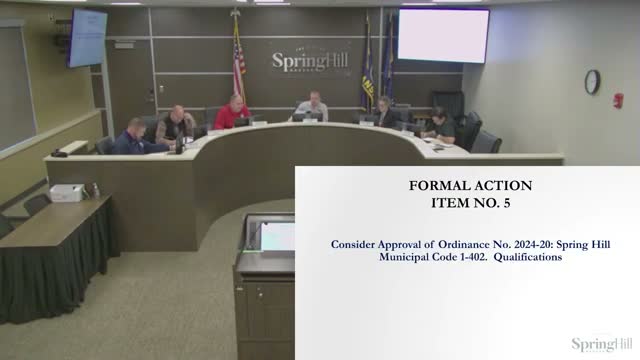
Summary
The Spring Hill governing body on Dec. 30, 2024, approved an ordinance requiring a newly hired chief of police to establish residency within a set period but allowing a joint mayor/city-administrator waiver in limited circumstances; vote was 6-0.
SPRING HILL, Kan. — The Spring Hill governing body on Dec. 30 adopted an amendment to the municipal code setting a residency expectation for the city’s next chief of police while creating a formal, limited exception process.
The ordinance, passed unanimously 6-0, requires a newly hired chief to establish residency within a reasonable period (the code sets 12 months as the minimum) but permits the mayor and the city administrator to jointly grant an exception “upon good cause shown,” a provision described in the measure as the exception option.
City staff presented three alternatives: keep the existing 30-minute-from-department requirement; require residency within city limits; or require residency with no exception. The staff report noted that a residency rule can affect the candidate pool and that comparable cities in the metro area follow differing approaches.
“Someone that has a child in school…maybe that could be something we could talk about the time frame,” said Councilmember (Speaker 3), arguing for flexibility while expressing a preference for an in-city chief. In contrast, Councilmember (Speaker 7) urged against a strict city-limits requirement, saying, “I don't I will not support anything that requires city limit requirement,” and warning it could sharply limit candidates.
When moving the ordinance, Councilmember (Speaker 6) said the adopted text was the exception option: “The option 1 requires residency of the Chief of Police within a reasonable period of time setting 12 months as the minimum. However, this option allows the mayor and city administrator jointly [to] consider a request of a chief not to live within the city upon good cause shown by the chief of police.”
City attorney Spencer clarified that if an exception is granted, the code would still require the chief to live within 30 minutes’ drive of the department: “city code would still require them to reside within 30 minutes drive of their department head.”
Supporters of the exception language said it preserves the ability to recruit widely while setting a clear expectation that the chief will move into the community; opponents said a strict city-limits requirement is more likely to produce a leader who is embedded in local life and trusted by residents.
The ordinance amends Article 4, Chapter 1 of the Spring Hill Municipal Code relating to residency for the chief of police. The council recorded the vote after a roll call; the mayor announced the ordinance passed 6-0.
The ordinance’s effective date was not specified during discussion; staff did not provide a public timeline for implementation beyond the text’s 12-month minimum for establishing residency. The council adjourned immediately after the vote.