Get Full Government Meeting Transcripts, Videos, & Alerts Forever!
Get email alerts on the Legislative Branch Budget topic
No spam. Unsubscribe anytime.
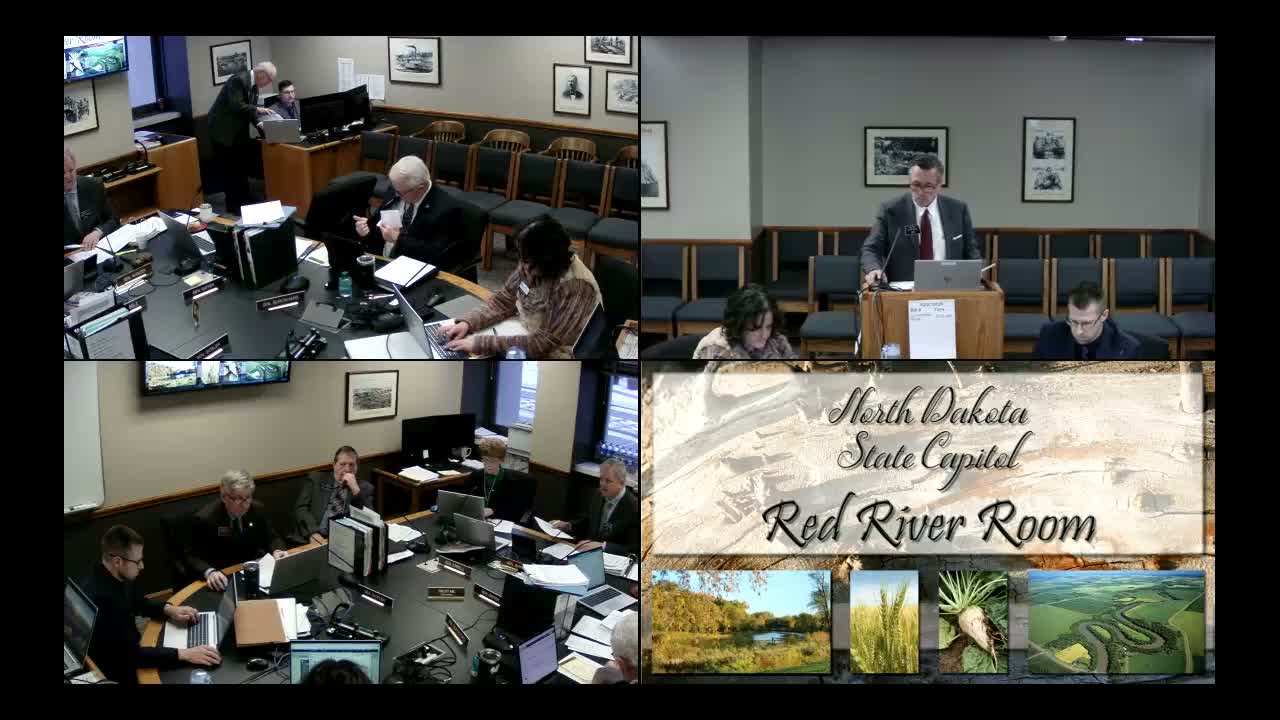
Appropriations panel approves two amendments to Legislative Branch budget for term‑limits and nuclear studies
Summary
The Government Operations Division voted to add two amendments to the Legislative Branch budget: $225,000 for an outside study on the effects of term limits and $325,000 for a legislative study on the advisability and feasibility of siting or incentivizing a nuclear facility in North Dakota.
The Appropriations Committee (Government Operations Division) voted to add two amendments to the Legislative Branch budget on a roll‑call vote, approving a $225,000 contract to study the effects of term limits on the legislative branch and a $325,000 legislative management study on nuclear power siting and feasibility.
Senator Hogue, who offered the amendments, told the committee the first would “authorize legislative counsel and legislative management to select somebody who’s willing to study those impacts and report back to legislative management.” He described the $225,000 item as a contract for outside expertise because, he said, legislators are naturally self‑interested and the branch lacks in‑house expertise for all the questions the term‑limits proposals raise.
On the nuclear item Hogue said the change in tone nationally toward nuclear power and recent interim committee work justify a directed study: “the nuclear study…is too important for us to defer for another session,” he said, noting the House’s related measure (House Bill 1025) had moved forward in committee but might not succeed. Hogue cited Wyoming’s TerraPower project as a model of leveraging existing transmission and coal‑plant sites.
Committee members asked whether other pending bills — such as proposals to move to annual sessions or a National Guard‑style monthly meeting model — should be folded into the term‑limits review. Hogue said those topics could be considered as part of the study. Several senators urged that the term‑limits work be broad enough to evaluate staffing, legislative council needs and impacts to institutional knowledge.
The motion to include the two amendments was moved by Senator Dwyer and seconded by the Chair. A roll‑call vote recorded affirmative responses from Senators Wozniak, Burkhart, Dwyer, Herbili and Sickler; the Chair announced the motion passed and the amendments will be added to the committee amendment for Senate Bill 2001.
Next steps: the committee recessed briefly and told staff to prepare amendment language for inclusion in the committee’s package. The added study appropriations are for interim or legislative‑management directed work and do not by themselves change any statutory term‑limit policy; they fund analysis and reporting back to the legislature.
Who said it: direct quotes and attributions in this story come from committee discussion reported on the record.