Get Full Government Meeting Transcripts, Videos, & Alerts Forever!
Get email alerts on the Youth Court topic
No spam. Unsubscribe anytime.
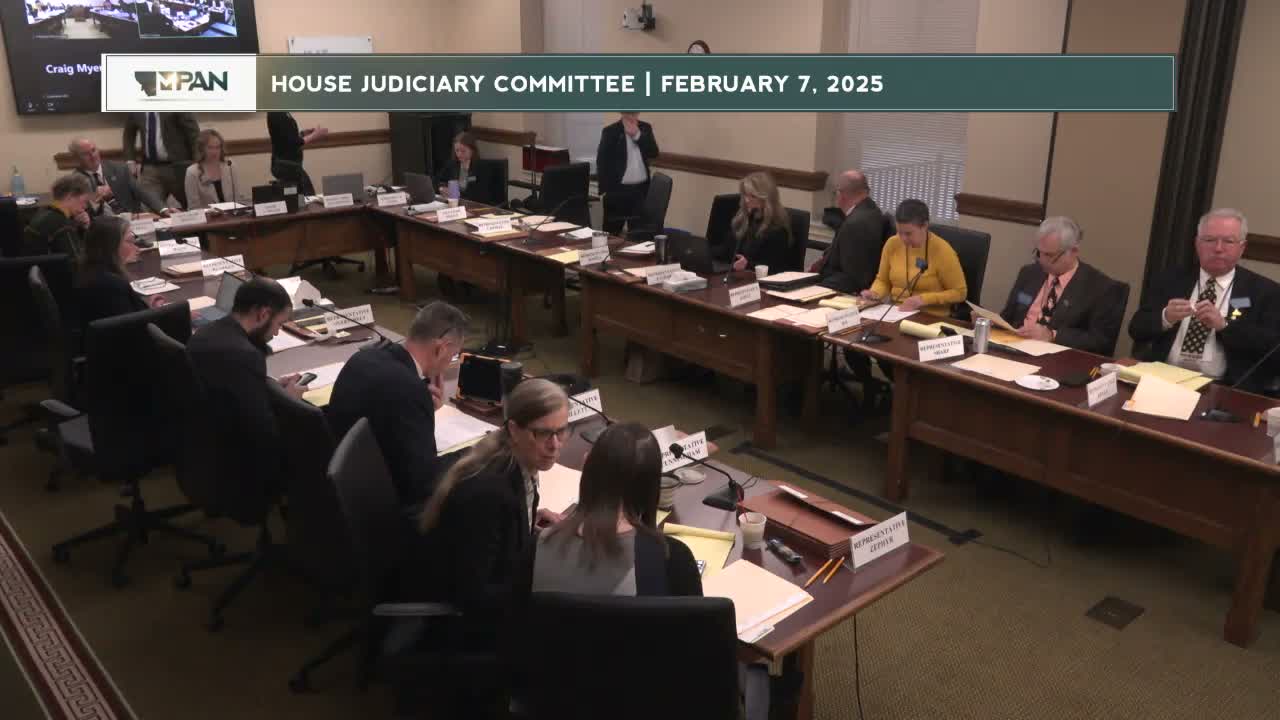
Montana Judiciary Committee hears bill to update Youth Court transfer list; advocates disagree on public safety and youth harm
Summary
Representatives and witnesses debated HB332, which would add several violent offenses to the list that county attorneys may directly file in district court and revise consent‑decree and sight‑and‑sound language; prosecutors said it closes gaps, civil‑liberties and youth‑defense groups warned it risks prosecuting younger children as adults and straining defenders.
Representative Bill Mercer (R‑House District 52) opened the House Judiciary hearing on House Bill 3 32, telling the committee the measure updates the Montana Youth Court Act to reflect newer offenses and to close procedural gaps that have caused inconsistent court interpretations. "We spent a lot of time on [this bill] in 2023," Mercer said, calling it "a good idea then, and a good idea now."
Proponents included Hallie (Ellie) Bishop, deputy chief and chief juvenile prosecutor with the Yellowstone County Attorney's Office, who testified the bill is primarily a "cleanup" to correct statutory cross‑references and to make recent criminal definitions usable in the transfer statute. Bishop said several serious crimes enacted since the original language (for example, statutes enacted in 2017 and 2005) are not reflected in the transfer provisions and that county attorneys need those options in rare, violent cases. "This bill is to fix the procedural gaps within informal adjudication of juvenile offenders," Bishop said, and she urged members to ask follow‑up questions.
Dan Brooks, representing the Billings Chamber of Commerce, told the committee that public safety and a local uptick in youth violence motivated his group's support. He said local law enforcement and municipal leaders have asked for legislative fixes to ensure the justice system can address serious juvenile‑involved violence.
Opponents including Henry Seaton of the ACLU of Montana, Amy Borror of the Gault Center, Nicole Gomez of Catalyst Montana, and youth‑court attorney Michelle Lyday urged rejection, saying the bill would expand the number of children prosecuted in adult court and expose youth to higher risk in adult facilities. Seaton described the measure as contrary to evidence on preventing youth crime and said the bill's punitive approach would undermine rehabilitation and risk placing youth in conditions that amount to solitary confinement in some rural settings. "HB 332 is rife with ineffective deterrents to crime and lacks actual investment in things that do work to deter that crime," he told the committee.
Lyday, who practices in youth court statewide, flagged three concerns: (1) the bill would allow direct filing of children as young as 12 for certain offenses; (2) changes to consent adjustments could undermine informal processes that now proceed without guaranteed counsel; and (3) alterations to consent‑decree language could move youth handling toward more punitive adult procedures. She said that 3,730 cases were handled informally in 2023 and that requiring counsel in many of those cases could strain the public‑defender system.
Committee members pressed witnesses on detail and data. Witnesses and the fiscal note discussed the added costs to the Office of Public Defender for transfer hearings, which the fiscal note estimates could range about $5,000 to $30,000 per case depending on expert witnesses and circumstances. Bishop and other panelists described a discretionary transfer process: county attorneys may file certain cases in district court, the district court must find probable cause, and within 30 days a hearing must determine whether the case should be returned to youth court, giving judges several statutory checks. Bishop also emphasized that mandatory adult sentencing minimums do not automatically apply to juveniles and that there is a sentencing‑review mechanism for youth sentenced as adults.
The committee heard extended questioning about how often discretionary filings occur and about geographic variation; witnesses said data are incomplete but that transfers are rare in many counties and more frequent in some jurisdictions dealing with severe juvenile violence. Representative Mercer said the bill responds to practice recommendations from county attorneys and the Yellowstone County Attorney's Office and emphasized that prosecutorial discretion and judicial hearings are intended checks on unnecessary adult prosecutions.
The committee closed the HB332 hearing without a vote; the bill will be available for further committee consideration.