Riverside PZC recommends clarifying rules for pervious, semi‑pervious and impervious surfaces
Summary
The Planning and Zoning Commission voted unanimously Dec. 17 to recommend text amendments that define pervious, semi‑pervious and impervious surfaces, add implementation steps (permits and inspections) and preserve existing nonconforming coverage while preventing increases; the recommendation goes to the village board for final action.
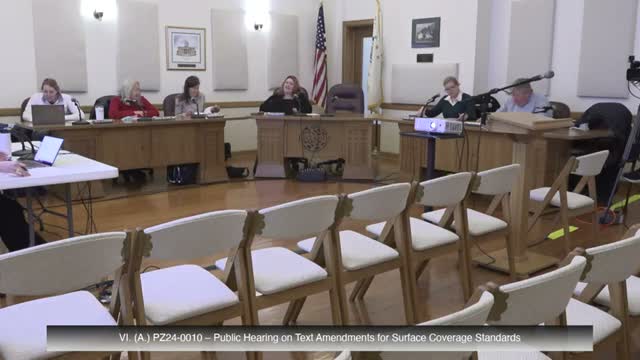
The Village of Riverside Planning and Zoning Commission on Dec. 17 recommended that the village board adopt text amendments clarifying how pervious, semi‑pervious and impervious surfaces are defined and measured in residential zoning districts. The commission voted to forward the changes after staff outlined implementation steps and commissioners requested wording clarifications.
Anne, a village staff member, told the commission the purpose of the amendments is “to define and provide standards for pervious, semi pervious, and impervious surfaces for properties in the residential zoning districts.” She said semi‑pervious surfaces that retain the first inch of stormwater and are approved by the village engineer would be treated as 80% impervious and 20% pervious for coverage calculations (a 20% discount). Staff also noted that the amendments do not change grandfathering for previously approved installations: properties that are legally nonconforming may keep existing coverage but cannot increase the total impervious coverage and must come into compliance when more than 50% of the hardscape is removed.
Commissioners focused on implementation and clarity. Staff described the permitting and inspection sequence: applicants would obtain building permits and, where required, grading permits; the village engineer would review design details and carry out two technical inspections (excavation depth and substrate), followed by a final inspection by the building inspector. Commissioners asked staff to tighten language where definitions used different verbs (for example, comparing “restricts” versus a later 90% “prevents” infiltration test) and to clarify how compacted dirt or gravel should be treated in practice if it causes runoff to neighboring properties. Staff said attorney review has occurred on the packet and that edits responding to these comments will be incorporated before the ordinance goes to the village board.
During discussion commissioners also asked staff to clarify measurement conventions for eaves and overhangs (the proposal subtracts an 18‑inch band from impervious calculations) and to modify the stormwater runoff definition to make explicit that runoff which leaves the lot (rather than simply not immediately infiltrating at the point of contact) is the intended trigger for drainage concerns.
A motion to approve the draft with the clarifying edits (language changes to the catch‑all impervious provision, the eaves/overhang measurement and the stormwater runoff sentence) passed on a roll‑call vote; all commissioners present voted in the affirmative. The commission’s findings of fact and recommendation will be forwarded to the village board for consideration at a future meeting.